This post is also available in:
 日本語
日本語  Türkçe
※この記事内にはプロモーションが含まれています。
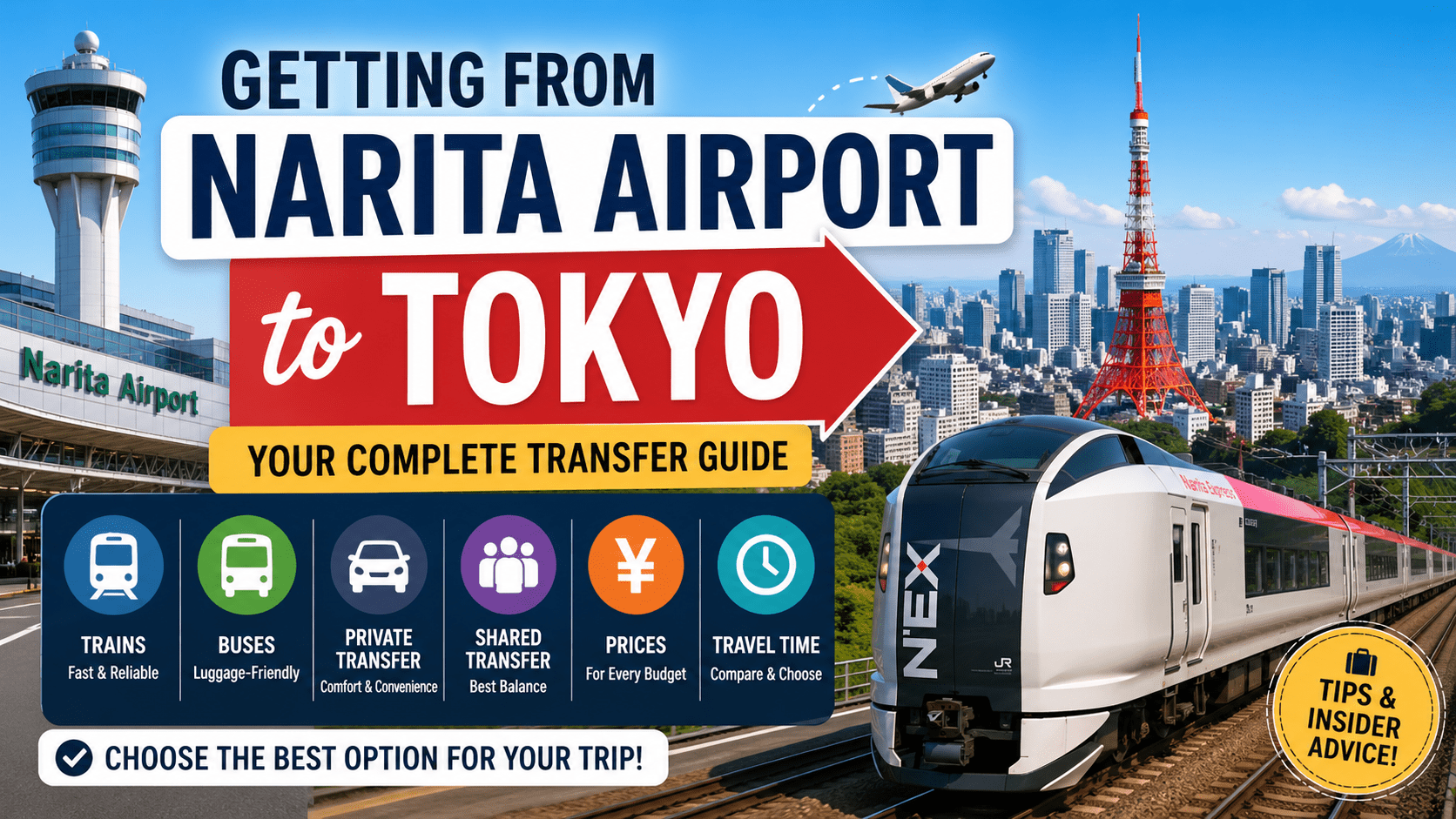
Arriving at Narita International Airport is an exciting first step in your Japan journey—but getting from the airport to central Tokyo can feel overwhelming, especially after a long flight. Located roughly 60 kilometers from the city center, Narita isn’t exactly “next door,” and choosing the right transfer option can make a significant difference in how smoothly your trip begins.
Travelers typically weigh several factors: cost, travel time, comfort, and how easy it is to navigate with luggage. The good news is that Tokyo offers one of the most efficient and diverse airport transfer systems in the world. Whether you’re looking for the fastest train, the cheapest route, or a stress-free door-to-door service, there’s an option tailored to your needs.
In this guide, you’ll find a complete breakdown of every major way to get from Narita Airport to Tokyo—along with practical recommendations and booking tips. If you prefer a seamless, hassle-free arrival, services like NearMe offer shared door-to-door rides. Meanwhile, platforms such as Klook make it easy to reserve taxis, trains and buses in advance.
Narita Airport Overview & Transfer Basics
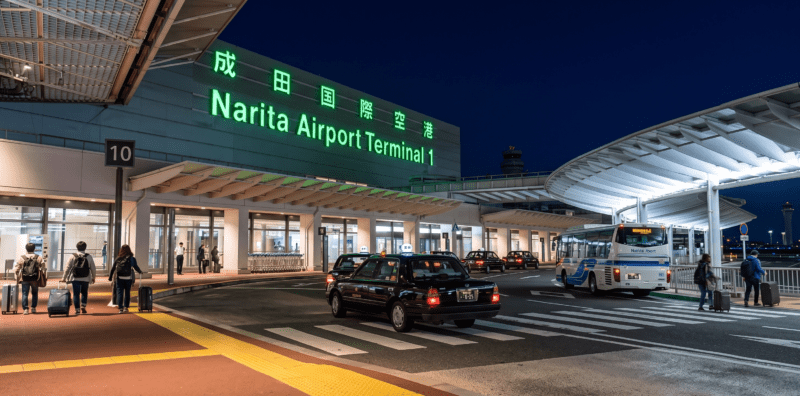
Narita Airport serves as Tokyo’s primary international gateway, handling millions of passengers each year. Despite its distance from central districts like Shinjuku, Shibuya, and Tokyo Station, it’s extremely well connected by rail, road, and private transfer services.
Before choosing your transportation, consider these key variables:
- Arrival time: Late-night arrivals limit your options, especially for trains
- Destination: Some services go directly to major hubs, others require transfers
- Luggage: Large suitcases can make trains less convenient
- Budget vs comfort: There’s a wide range—from ¥1,000 local trains to premium private rides
A simple rule: the “best” option depends on your balance of convenience, cost, and energy level after arrival.
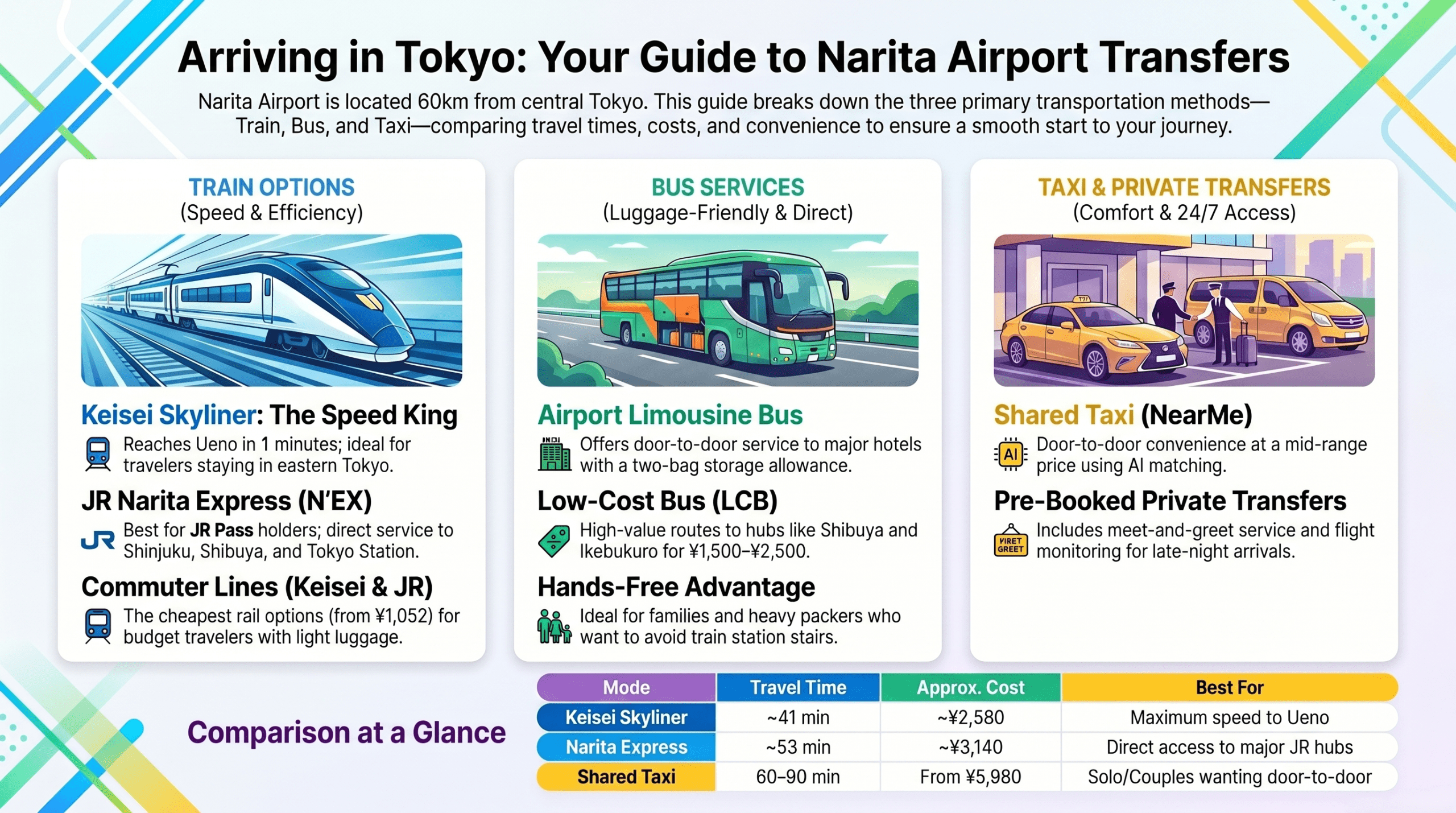
Quick Comparison: Transport Options at a Glance
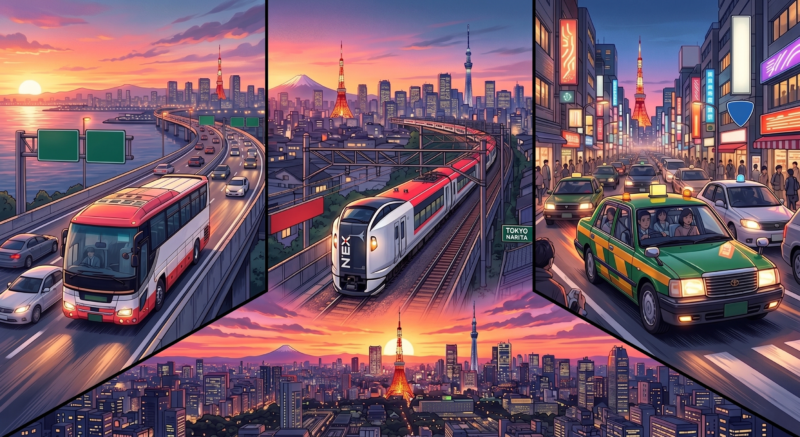
Here’s a snapshot of the most common ways to travel from Narita Airport to Tokyo:
| Mode | Travel Time | Approx. Cost (Adult) | Best For |
|---|---|---|---|
| Keisei Skyliner | ~41 min to Ueno Station | ~¥2,580 | Speed, travelers to Ueno/Asakusa/Akihabara |
| JR Narita Express (N’EX) | ~53 min to Tokyo Station | ~¥3,140 | JR Pass holders, travelers to Shinjuku/Shibuya/Yokohama |
| Keisei Main Line | ~80–90 min to Ueno Station | ~¥1,052 | Budget travelers, light luggage |
| JR Sobu/Yokosuka Line (Rapid Service) | ~90+ min to Tokyo Station | ~¥1,400 | Budget travelers, light luggage |
| Airport Limousine Bus | 90–130 min | ¥3,100–¥3,600 | Heavy packers, hotel-door service |
| Low-Cost Bus (LCB) | 90–120 min | ¥1,500-¥2500 | Budget travelers, heavy luggage |
| Regular Taxi | 60–90 min | ¥20,000–¥30,000+ | Last-minute |
| Shared Taxi (NearMe) | 60–90 min | From ¥5,980~ | Families, heavy luggage, door-to-door ease |
| Private Taxi (NearMe / Klook) | 60–90 min | From ¥25,800~ | Groups (4+), late-night arrivals, VIP service |
Trains
For independent travelers who pack light and know their way around a rail network, the train is the most efficient way into Tokyo. Departures are frequent, the journey is unaffected by road traffic, and the tickets are easy to buy at the airport. There are four options, split between express and commuter services.
Express Train: Keisei Skyliner
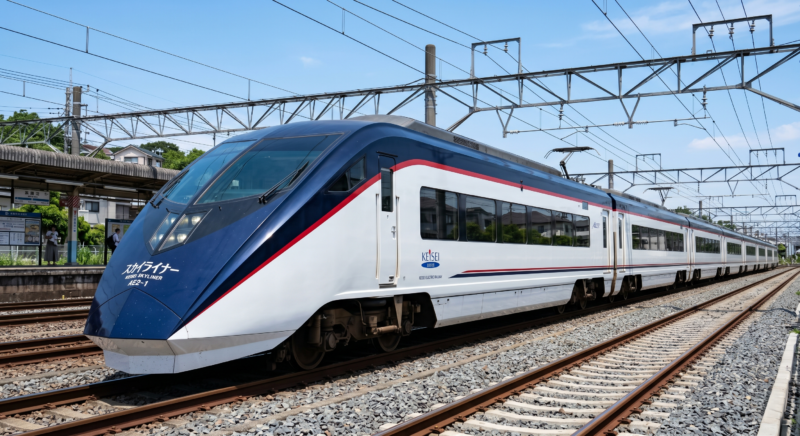
The Skyliner is the undisputed king of speed, reaching 160 km/h. It connects Narita to Nippori and Ueno stations in eastern Tokyo.
From Ueno, you can transfer easily onto the Tokyo Metro and JR Yamanote Line for access to the rest of the city. From Nippori, the Yamanote Line connects to Shibuya, Shinjuku, Harajuku, and other popular destinations.
- The Route: It runs non-stop from the airport to Nippori (36 mins) and Keisei Ueno (41 mins).
- Comfort: All seats are reserved, featuring under-seat power outlets and dedicated luggage racks.
- The Klook Advantage: Booking your [Keisei Skyliner ticket via Klook] is highly recommended. Not only is it roughly 10% cheaper (approx. ¥2,310) than buying at the counter, but you also receive a QR code. In 2026, you can simply scan this at the digital machines to select your seat, skipping the long manual queues.
- Best for: Travelers staying in Ueno, Asakusa, Akihabara, or those transferring to the JR Yamanote Line at Nippori.
Express Train: JR Narita Express (N’EX)
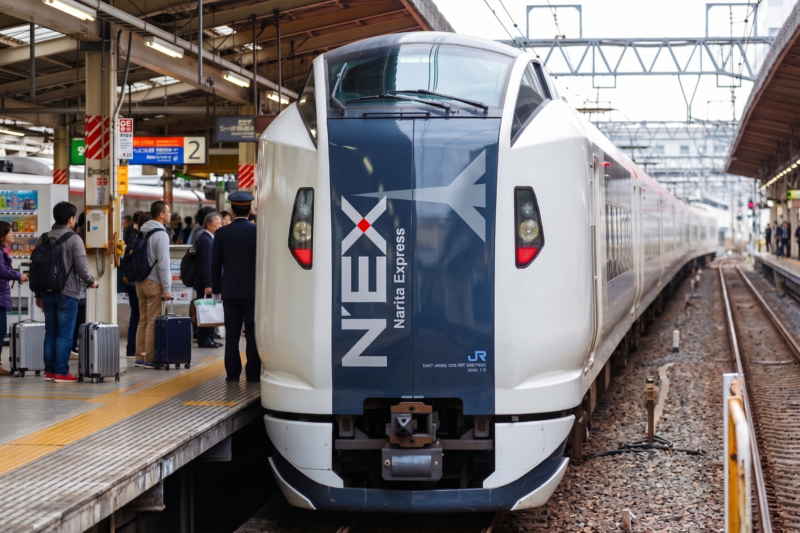
The N’EX is the flagship service of JR East. It is the best option for those staying in the massive hubs of western and central Tokyo.
- The Route: It serves Tokyo Station (53 mins), Shinagawa, Shibuya, and Shinjuku. Some trains even continue to Yokohama.
- Features: Extremely spacious, with enhanced features such as Wi-Fi and luggage locks.
- Pricing: A one-way trip to Tokyo Station costs around ¥3,140. However, the N’EX Round Trip Ticket (approx. ¥5,000 for a 14-day return) remains the best value for visitors.
- Best for: JR Pass holders (it’s fully covered) and anyone staying within walking distance of the major JR hubs.
Commuter Train: Keisei Main Line
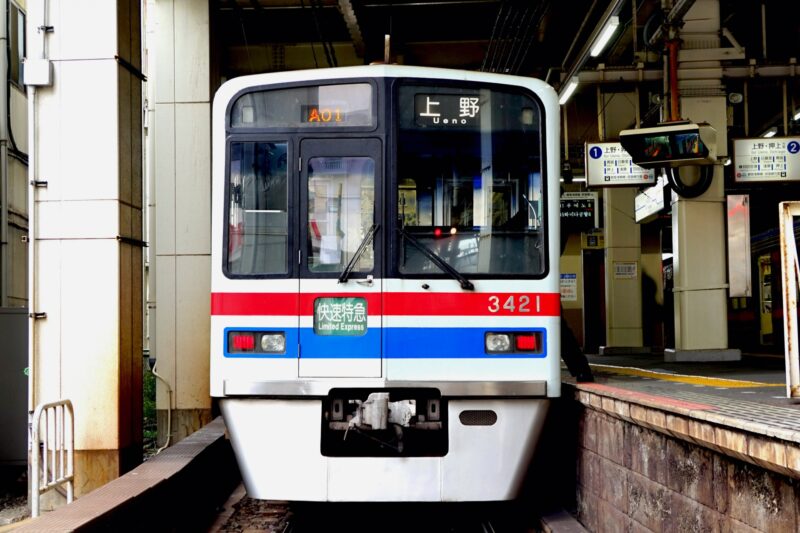
The Keisei Main Line is the budget traveler’s best-kept secret from Narita. It runs the same corridor as the Skyliner but stops at many more stations along the way, making it slower — but significantly cheaper.
- The Route: It runs from Narita Airport Terminal 1 and Terminal 2·3 stations to Nippori and Keisei Ueno (approx. 75–90 mins), stopping at several local stations in Chiba and East Tokyo along the way
- Features: A standard commuter train with no reserved seating, no dedicated luggage racks, and no advance booking. Tickets can be purchased on the day from a ticket machine, or you can simply tap and go using your Suica or PASMO without needing a paper ticket or additional supplement. Carriages can become crowded during rush hour, so it is advisable to travel outside peak times if you have large luggage.
- Pricing: A one-way fare from Narita Airport to Keisei Ueno is approximately ¥1,052 — less than half the price of the Skyliner. No surcharge, no reservation fee.
- Best for: Budget-conscious solo travelers with light luggage who are comfortable navigating a local train and don’t mind trading speed for savings.
Commuter Train: JR Sobu/Yokosuka Line (Rapid Service)
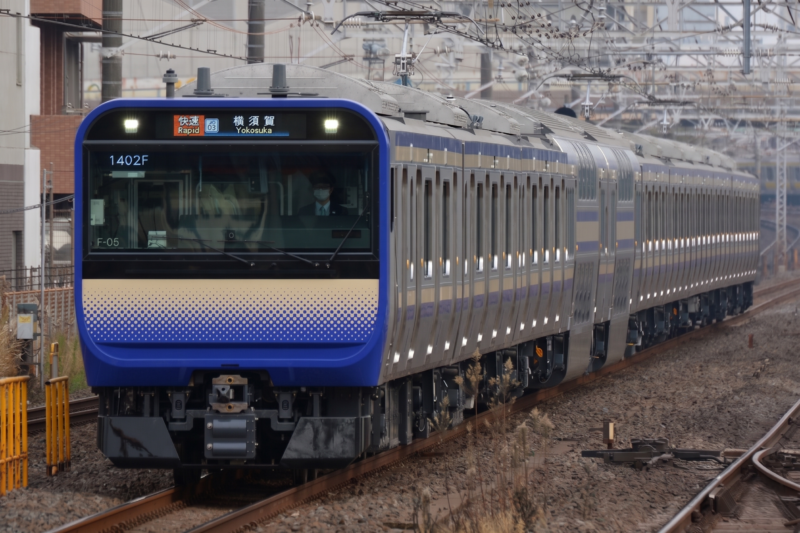
The JR Sobu/Yokosuka Line is the least-known train route from Narita, and for good reason — it requires more navigation than the other options. That said, it opens up direct access to stations that neither the Skyliner nor the N’EX serve, making it a genuine option for travelers staying in certain parts of central Tokyo.
- The Route: Connects Narita Airport directly to Tokyo Station (approx. 90 mins), Shinagawa, and continues on to Yokohama and Kamakura. Unlike the N’EX, it makes several stops at local business and residential hubs like Chiba and Kinshicho.
- Features: A standard JR commuter train — no reserved seating, no luggage racks, and no advance booking required. Tickets are purchased at the station on the day, or you can tap in with a Suica or PASMO IC card. Carriages can be busy during peak hours, and large suitcases in a crowded carriage are not ideal.
- Pricing: A one-way fare from Narita Airport to Tokyo Station is approximately ¥1,400. JR Pass holders can use this route at no additional cost, though the N’EX is generally the better use of the pass given its speed and comfort.
- Best for: Suitable for experienced Japan travelers who are already familiar with the rail network, budget-conscious travelers who prefer the JR network, and those heading to Yokohama who do not mind a longer travel time.
Buses
Buses ask you to trade speed for comfort and convenience — particularly when it comes to luggage. Your bags go in a large storage compartment underneath the coach, you board once, take your seat, and don’t move until you reach your stop. For travelers arriving with two large suitcases and no desire to navigate stairs and ticket gates, the bus is quietly one of the best options available.
Narita Airport Limousine Bus
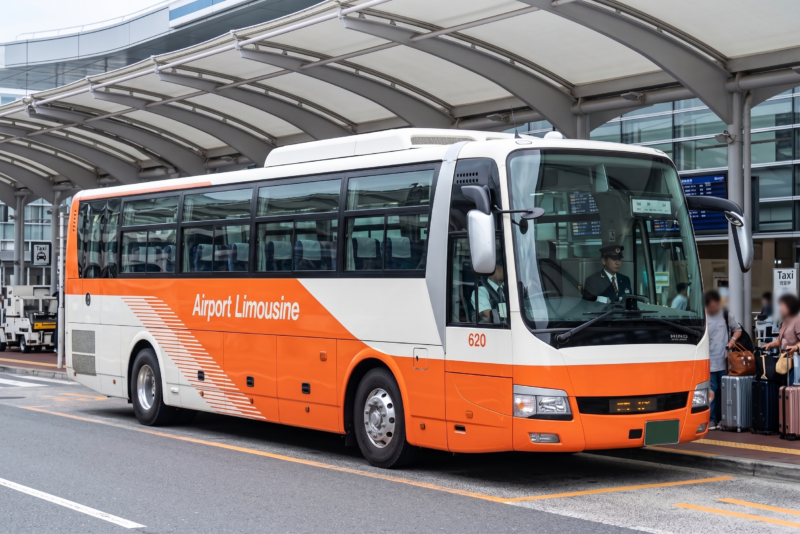
Operated by Airport Transport Service Co., the Limousine Bus is Japan’s most established airport coach service, recognizable by its iconic orange branding throughout Narita’s arrivals halls. Routes run directly to major hotels and transport hubs across Tokyo — Shinjuku, Shibuya, Ginza, Tokyo Station, Marunouchi, Ikebukuro, and more — with some routes serving individual hotel drop-offs. The journey takes approximately 90–130 minutes depending on your destination and traffic conditions. A one-way adult fare is around ¥3,100–¥3,600.
The Limousine Bus offers free Wi-Fi, onboard restrooms, USB charging ports, and a generous luggage policy — each passenger may check up to two large suitcases. Tickets can be purchased at counters and machines in the arrivals hall of all three terminals, or booked in advance online through platforms like Klook, which sometimes offer slight discounts and allow you to board using a simple QR code.
Best for: Travelers with heavy luggage, families, and anyone whose hotel is served by a direct Limousine Bus route.
Low-Cost Bus (LCB)
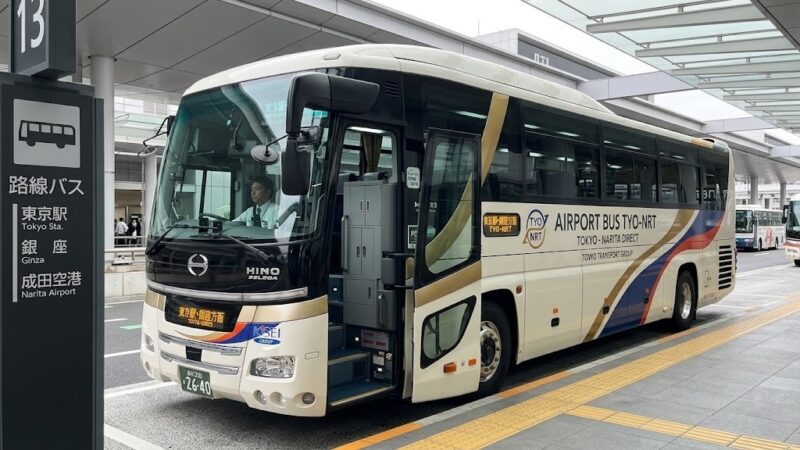
For travelers who want door-to-door bus convenience without the Limousine Bus price tag, Narita’s Low-Cost Bus network offers surprisingly broad coverage across Tokyo at a fraction of the cost. Multiple operators run competing routes, so the right one depends entirely on where you’re headed.
- The Routes: Five destinations are currently served by LCB operators:
- Airport Bus TYO-NRT (Tokyo Station / Ginza Station / Shinonome Aeon-mae) — ¥1,500 (operated by Keisei Bus, stops at Tokyo Station Yaesu Exit, Ginza Station and Shinonome Aeon-mae)
- Ikebukuro — ¥2,300 regular fare, ¥1,900 with online prepayment (operated by WILLER EXPRESS, stops at Ikebukuro Station West Exit)
- Shibuya — ¥2,500 (operated by Tokyu Bus, stops at Shibuya Station / SHIBUYA FUKURAS)
- Toyosu Market — ¥1,800 (operated by Keisei Bus Chiba East, stops at Michi Terrace Toyosu)
- Shin-kiba / Shiomi — ¥1,500, or ¥1,400 with online prepayment (operated by WILLER EXPRESS, stops at Shin-kiba Station and Tokyo Bay Shiomi Prince Hotel)
- Features: A no-frills coach service with limited amenities compared to the Airport Limousine Bus. Baggage allowances are more restrictive, so check your operator’s policy before booking. The Airport Bus TYO-NRT cannot be booked in advance — tickets are purchased on the day at the bus stop or counter with cash or credit card and IC cards (Suica, PASMO) are also accepted. Other routes such as Ikebukuro and Shin-kiba offer online prepayment with a small discount.
- Pricing: Fares range from ¥1,400 to ¥2,500 depending on your destination and whether you book online in advance.
- Best for: Budget travelers whose destination happens to align with one of the LCB drop-off points — particularly those heading to Ikebukuro, Shibuya, or the Tokyo Bay area who want to avoid a train transfer after a long flight.
Taxis and Private Transfers
The taxi category covers the widest range of options — from a spontaneous roadside cab to a fully pre-arranged private transfer with a professional driver waiting at arrivals. What all taxi and private car options share is the same core appeal: door-to-door service with no transfers, no ticket machines, and no crowds. You step off your flight, you get in a vehicle, and you get out at your hotel. That simplicity has real value after a long-haul flight.
Regular Taxi
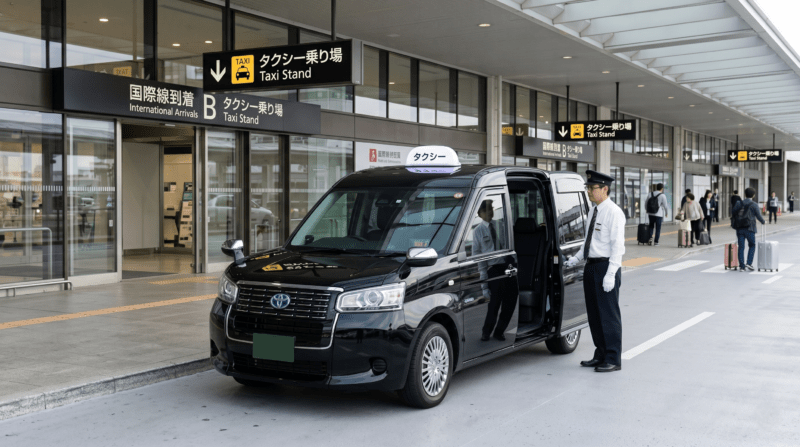
Standard metered taxis are available at the taxi rank immediately outside the arrivals exit at all terminals. No advance booking is needed. However, the cost is significant — expect to pay ¥20,000–¥30,000 or more for a one-way trip to central Tokyo, depending on traffic and your destination. Drivers may have limited English ability, and there is no flight monitoring or guaranteed wait if your flight is delayed.
Best for: Last-minute situations, or a larger group splitting the fare where the per-person cost becomes reasonable.
Pre-Booked Shared Taxi — NearMe
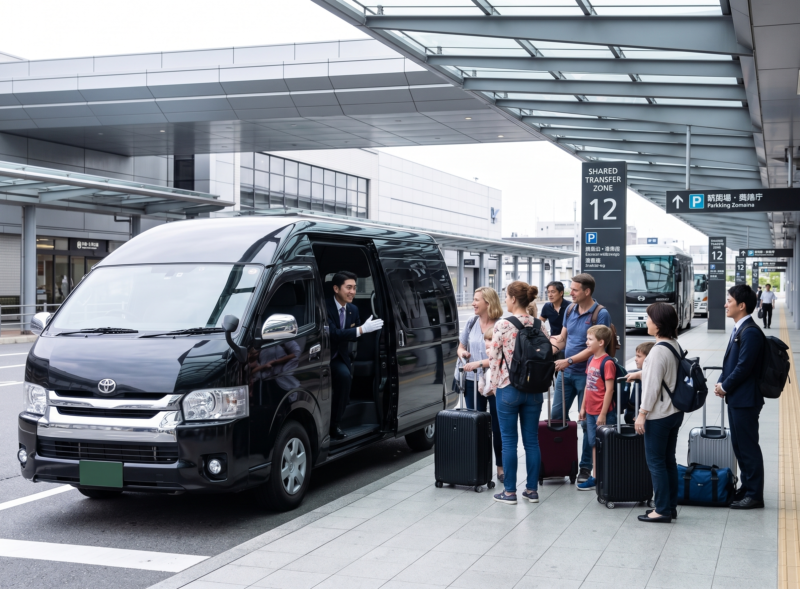
NearMe is a Japanese AI-powered mobility app that pairs travelers heading in the same direction into shared rides, splitting the cost between passengers. The result is door-to-door service from Narita to your hotel at a meaningfully lower price (from ¥5,980~) than booking a full private car. Booking is done in advance through the NearMe app, which is available in English. The AI matching system ensures you’re paired with passengers going your way, so the ride remains efficient rather than a roundabout detour.
Best for: Solo travelers and couples who want the convenience of a door-to-door transfer without paying full private car rates.
👉 Book a shared ride with NearMe
Pre-Booked Private Taxi — NearMe and Klook

For the most seamless, stress-free arrival experience, a pre-booked private transfer is hard to beat — and there are two strong options.
NearMe offers fixed-price (from ¥25,800~) private hire cars connecting Narita to hotels nationwide, with vehicles that can accommodate up to 9 passengers. The app-based booking process is straightforward and available in English, and fixed pricing means no surprises when you arrive.
👉 Book a private taxi with NearMe
Klook offers a similarly polished experience, with professional drivers providing a meet-and-greet service at the arrivals hall — your driver will be waiting with a name sign so there’s no hunting around. Vehicle options are extensive, covering everything from compact sedans to large coaches, covering Tokyo’s 23 wards, Shinjuku, major hotels, and surrounding areas. One of the standout features is flight delay coverage: your driver monitors your flight in real time and will wait at no extra charge if you land late. Booking is confirmed instantly online, and everything is handled via a mobile voucher — nothing to print, nothing to exchange.
👉 Book your Narita private transfer on Klook
For families arriving jet-lagged with children in tow, for business travelers who need a reliable and professional first impression, or for any first-time visitor who simply wants their arrival to be the least stressful part of the trip — a pre-booked private transfer is one of the smartest investments you can make.
Best for: Families, groups, business travelers, first-time visitors, and anyone arriving with heavy luggage.
How to Choose the Right Option for You
Still not sure? Use this quick guide:
- Solo traveler, who prefer speed → Keisei Skyliner (Nippori/Ueno) or JR Narita Express (N’EX) (Tokyo/Shinjuku/Shibuya/Yokohama)
- Solo traveler, tight budget → Keisei Main Line or Low-Cost Bus
- Solo or couple with heavy luggage → Airport Limousine Bus or NearMe shared taxi
- Couple wanting door-to-door comfort → NearMe shared taxi
- Family with kids and bags → NearMe private transfer or Klook private transfer
- Business traveler needing reliability → NearMe private transfer or Klook private transfer
- Group of 6–9 people → Klook 10-seater (most cost-effective per person)
- JR Pass holder → JR Narita Express (N’EX) (covered by the pass)
Insider Tips for a Smooth Transfer
A few practical tips can make your arrival much smoother:
- Get an eSIM before landing: Set up mobile data in advance so you can access maps, booking details, and contact services immediately after arrival. This is especially useful when coordinating pickups or navigating train routes without relying on airport Wi-Fi.
👉 Stay connected from the moment you arrive — book your eSIM on Klook - Get an IC card: Cards like Suica or PASMO allow seamless travel on trains and buses
- Avoid rush hours: Tokyo trains are extremely crowded between 7–9 AM and 5–7 PM
- Plan for airport processing: Immigration and baggage claim can take 30–60 minutes
- Consider luggage forwarding: Services can deliver your suitcase directly to your hotel
These small steps can significantly reduce stress, especially on your first day in Japan.
Narita to Tokyo FAQs
- QWhat is the fastest way to get from Narita Airport to Tokyo?
- A
The fastest option is the Keisei Skyliner, which reaches Ueno in about 41 minutes. However, you may need to transfer depending on your final destination.
- QWhat is the cheapest way to get to Tokyo from Narita Airport?
- A
Budget travelers can take local trains such as the Keisei Main Line, with fares starting from around ¥1,000. While affordable, these trains can be crowded and may not be ideal if you’re carrying large luggage.
- QIs there a direct train from Narita Airport to Tokyo Station?
- A
Yes, the Narita Express operated by JR East offers direct service to Tokyo Station, as well as major hubs like Shinjuku and Shibuya. You can also take the JR Sobu/Yokosuka Line (Rapid Service), which provides a direct connection to Tokyo Station at a lower cost. However, it takes longer and can be more crowded, with limited space for luggage.
- QDo I need to book in advance?
- A
For NearMe and Klook private transfer, yes—at least 24–48 hours in advance is recommended. For the Keisei Skyliner and Narita Express, booking via Klook ahead of time saves you money and allows you to skip the long ticket counter lines by using a QR code at the vending machines.
- QIs there a way to travel “hands-free” to my hotel?
- A
Absolutely. Use a Takkyubin (Luggage Delivery) service like Yamato Transport or JAL ABC, found in the arrivals hall. For about ¥2,500, they will ship your large suitcases directly to your hotel. If you drop them off before 10:00 AM, you may even get same-day delivery to central Tokyo.
- QI’m arriving after 11:00 PM. Are there still trains?
- A
Most trains stop running around 11:00 PM to 11:30 PM. If your flight lands late, your best options are:
- NearMe Shuttle: Pre-booked shuttles operate 24/7.
- Klook Private Transfer: A driver will wait for you regardless of the hour.
- QCan I use my JR Pass from Narita Airport?
- A
Yes, the JR Pass covers the Narita Express, making it a cost-effective option if you already have an active pass.
- QDo I need cash for transportation from Narita Airport?
- A
Summary
Narita Airport is about 60 km from central Tokyo, and that distance shapes your arrival experience. Getting from the airport to your hotel isn’t a small detail—it’s the first real part of your trip. Choose the wrong option, and you might spend two hours struggling with your luggage on crowded trains. Choose the right one, and you’ll arrive at your hotel relaxed, comfortable, and ready to start your journey.
The good news is that Japan’s transport infrastructure is exceptional, and every option in this guide will get you there safely and efficiently. The question is simply which combination of speed, cost, convenience, and comfort fits your situation best.
For most first-time visitors — particularly those traveling with luggage, arriving in a group, or simply wanting to begin the trip on the right foot — a pre-booked transfer through NearMe or Klook removes every point of friction at the worst possible time of day. Your Japan adventure begins the moment you land — make sure the ride to your hotel is the least of your worries.
If you found this article or our activities helpful, we would greatly appreciate your support with a cup of coffee ☕✨