This post is also available in:
 日本語
日本語  Türkçe
※この記事内にはプロモーションが含まれています。
Are you considering studying abroad in Japan or pursuing serious Japanese language study domestically? Among the many Japanese language schools available, are you unsure which one will help you reliably achieve your goals?
If you have clear objectives such as “I want to master practical Japanese,” “I want to advance to a Japanese university, graduate school, or vocational school,” or “I want to succeed in finding employment at a Japanese company,” then the “ECC Kokusai College of Foreign Languages” located in the Umeda area in the heart of Osaka is highly recommended.
This school brings together international students from 42 countries worldwide and fosters active exchange with many Japanese students. With an overwhelming number of class hours and comprehensive support, it helps numerous international students achieve their dreams every year.
Based on the latest information for 2026, this article thoroughly explains why the ECC Kokusai College of Foreign Languages is chosen by international students from around the world—from the reasons behind its selection to course content by objective, tuition fees, and specific enrollment procedures. Please read to the end as a reference for choosing a school that will help you realize your dreams in Japan!
- Features of ECC Kokusai College of Foreign Languages
- Types of Japanese language courses and tuition at ECC Kokusai College of Foreign Languages
- Learning environment and international student support at ECC Kokusai College of Foreign Languages
- Enrollment procedures for ECC Kokusai College of Foreign Languages
- 1. What is ECC Kokusai College of Foreign Languages? Basic School Information
- 2. Build Real Skills! Six Features That Significantly Improve Japanese Language Ability
- Feature ① Overwhelming Study Hours and Comprehensive Support Through Homeroom System
- Feature ② Level-Based Class Organization Aligned with International Standards (CEFR)
- Feature ③ Learn Living Japanese! “Buddy Program” and Japanese Cultural Experiences
- Feature ④ Community Engagement Activities That Develop Human Skills Through Regional Exchange
- Feature ⑤ Abundant Opportunities for Presenting Results, Including Speech Contests
- Feature ⑶ Full Support for Advancement and Employment! Comprehensive Guidance and JLPT/EJU Preparation
- 3. Course Introduction by Objective (Long-term and Short-term Programs)
- 4. Tuition
- 5. Full Support for Advancement and Employment in Japan! Overwhelming Achievement Record
- 6. Optimal Learning Environment and Reliable International Student Support
- 7. Voices of Graduates
- 8. Admission Procedures
- Total Capacity
- Application Period
- Admission Eligibility
- Documents Required for Admission
- Flow Until Admission
- 9. Frequently Asked Questions (FAQ)
- Summary: For serious Japanese language study in Osaka, go to the ECC Kokusai College of Foreign Languages!
1. What is ECC Kokusai College of Foreign Languages? Basic School Information
First, let’s look at the basic information, including location, to understand what kind of school ECC Kokusai College of Foreign Languages is.
Excellent Access! Prime Location in Osaka’s Umeda Area
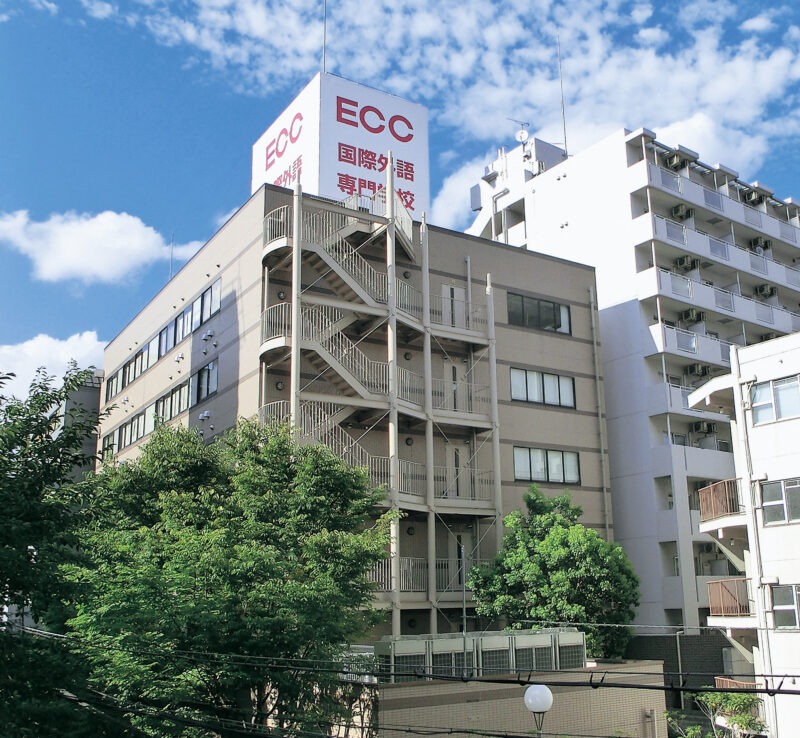
One of the attractions of ECC Kokusai College of Foreign Languages is its excellent accessibility for daily commuting. The school is centrally located in Osaka’s Umeda area, a major city in the Kansai region, with a six-story campus building situated in a very accessible location—approximately 10 minutes on foot from JR Osaka Station, western Japan’s largest terminal station. With Umeda as your base, traveling to popular tourist destinations such as Kyoto, Kobe, and Nara is extremely smooth, so you won’t lack for weekend activities.
Furthermore, “Nakazakicho,” where the school is located, is an attractive neighborhood extremely popular with young people, filled with cute cafes, retro yet modern vintage clothing stores, and general goods shops. You can enjoy Japanese conversation practice at cafes with your multinational classmates after class or go shopping at nearby commercial facilities—the perfect environment for a fulfilling student life. It’s a blessed location where even your daily commute becomes enjoyable.
A Global Environment Where International Students from 42 Countries and Japanese Students Come Together
The “Yamaguchi Gakuen Educational Foundation,” to which ECC Kokusai College of Foreign Languages belongs, is an educational institution with a history spanning over 40 years since its founding, boasting tradition and proven results in Osaka.
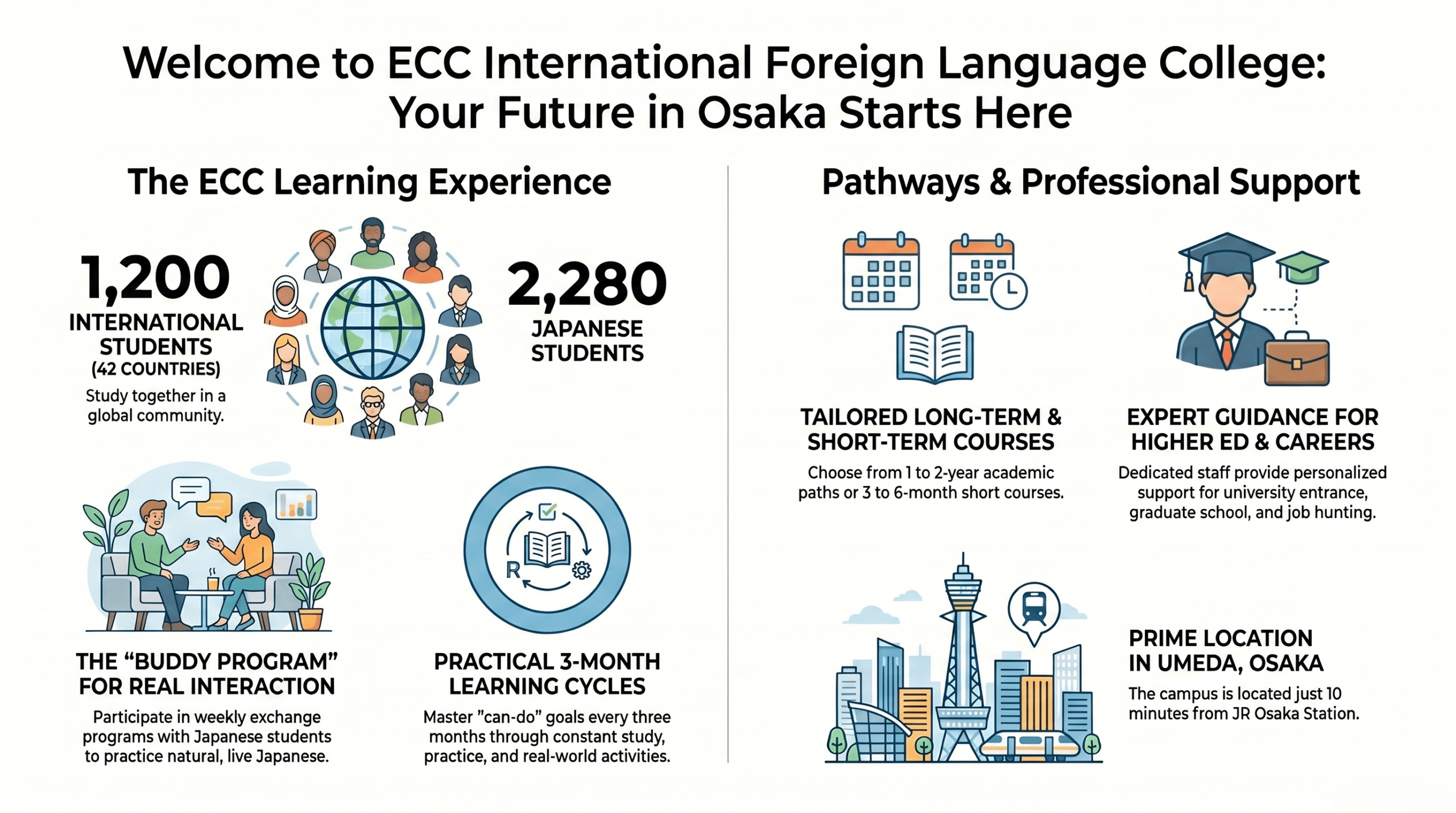
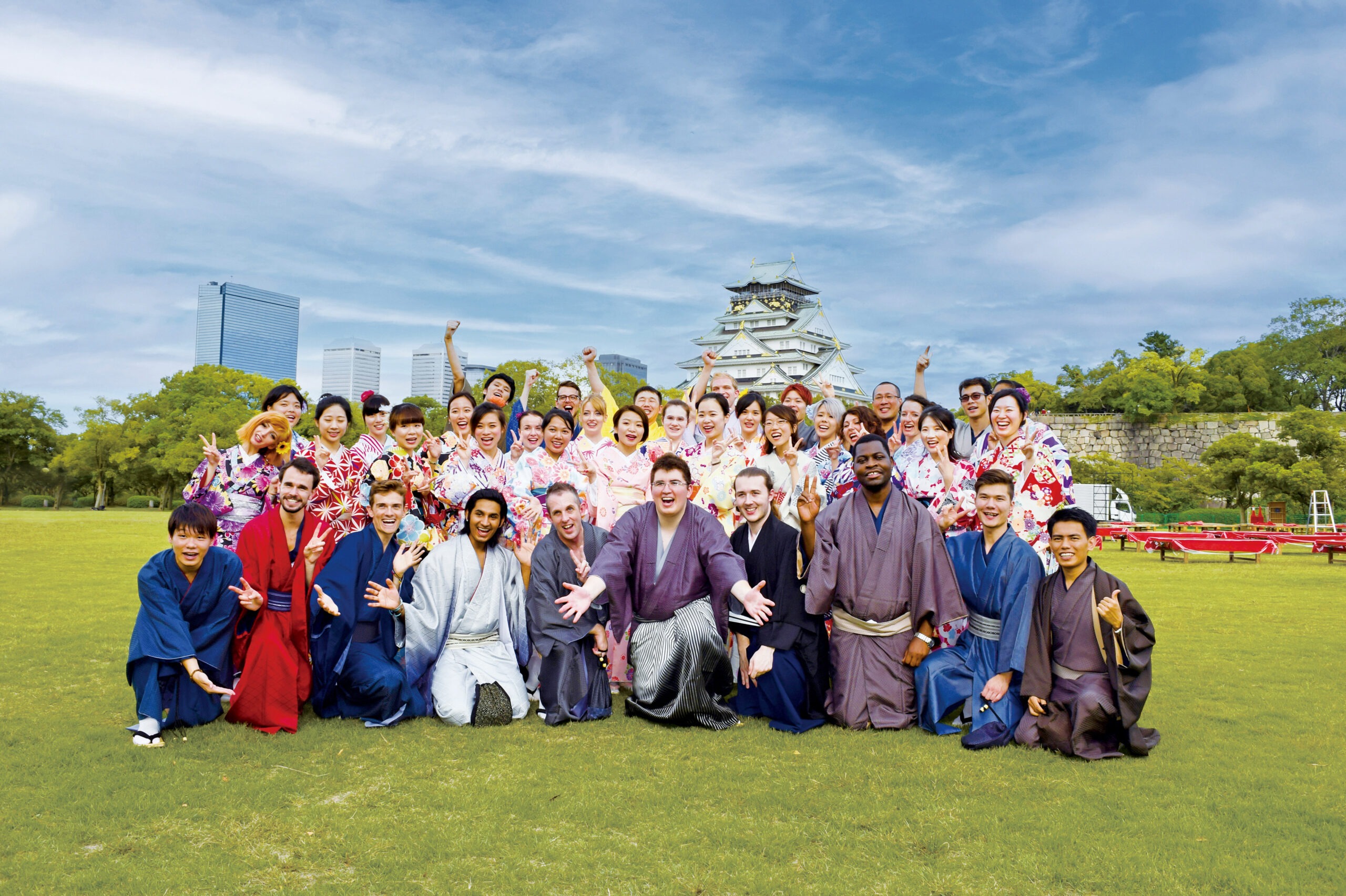
One of the school’s greatest attractions is its overwhelming scale and global environment where diverse cultures intersect. On campus, approximately 1,100 international students from 42 countries worldwide and approximately 2,280 Japanese students studying at vocational schools within the same educational foundation are enrolled together.
A Japanese language school where such a large-scale and multinational student body gathers under one roof is extremely rare even nationwide. Beyond simply learning Japanese grammar and vocabulary in the classroom, you can compete with classmates of different nationalities and interact daily with Japanese students of the same generation who pass through campus. While in Japan, you can naturally cultivate a “global mindset” that respects diverse cultures and values from around the world—truly an ideal learning environment.
Additionally, from April 2027, the school plans to start a new curriculum as a “Certified Japanese Language Education Institution” (application pending), further enhancing the quality of education.
Many Internal Transfers to Three Adjacent Vocational Schools
For international students who acquire solid Japanese language skills at ECC Kokusai College of Foreign Languages and wish to further study specialized skills in Japan, a very advantageous option called “internal transfer” within the Yamaguchi Gakuen Educational Foundation is available.
Transfer destinations include “ECC Kokusai College of Foreign Languages (Specialized Curriculum)” for studying languages, business, hotels, and trade; “ECC College of Computer & Multimedia” for studying IT, games, 3DCG, and web; and “ECC College of Beauty & Style” for honing skills in hairdressing, makeup, and nails—three schools to choose from.
The greatest advantage of this internal transfer system is that “full entrance fee exemption” and “tuition exemption system” are provided as significant financial support for internal transfer students. Since you can acquire cutting-edge specialized skills while keeping costs down in the familiar campus environment, an incredibly attractive and reassuring learning environment is in place for international students aiming for future employment in Japan’s IT/game industry, beauty industry, business/tourism industry, and more.
2. Build Real Skills! Six Features That Significantly Improve Japanese Language Ability
When it comes to studying abroad in Japan or Japanese language learning, what concerns you most is probably “Why should I choose ECC Kokusai College of Foreign Languages from among the many Japanese language schools?”
The answer lies in the school’s “unique educational methods and learning environment that reliably improve Japanese language ability,” cultivated through years of expertise. Here, we’ll explain in detail the “six features” highly valued by international students from around the world.
Feature ① Overwhelming Study Hours and Comprehensive Support Through Homeroom System
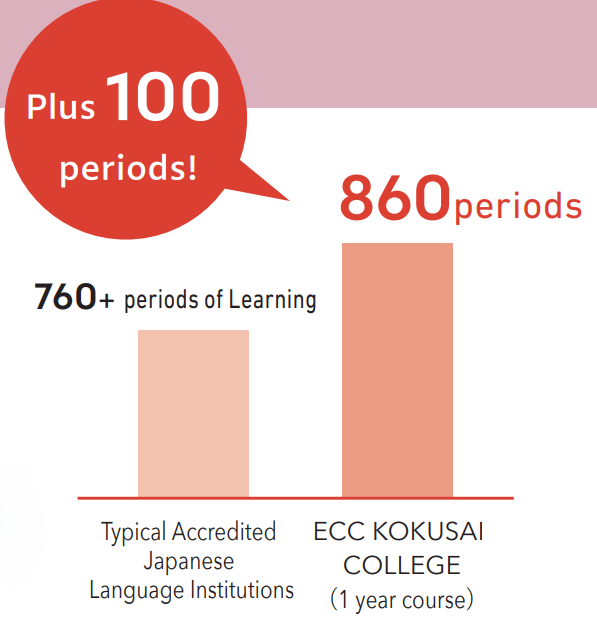
Securing sufficient study time is essential for language acquisition. While Japan’s Immigration Services Agency sets the standard for general Japanese language educational institutions at “760 class hours or more” per year, ECC Kokusai College of Foreign Languages secures an overwhelming 860 class hours per year, far exceeding that standard (*1 class hour = 45 minutes). This abundant learning volume makes it possible to thoroughly polish your “Japanese language ability” from basics to applications.
Another major attraction is the adoption of a “homeroom system” that supports each international student individually. Homeroom teachers not only provide academic guidance but also kindly listen to concerns and consultations about daily life in unfamiliar Japan. Sometimes strict, sometimes gentle, they support students like a “Japanese family” in tandem until graduation, creating an environment where you can concentrate on learning with peace of mind even during your first experience living in Japan.
Feature ② Level-Based Class Organization Aligned with International Standards (CEFR)
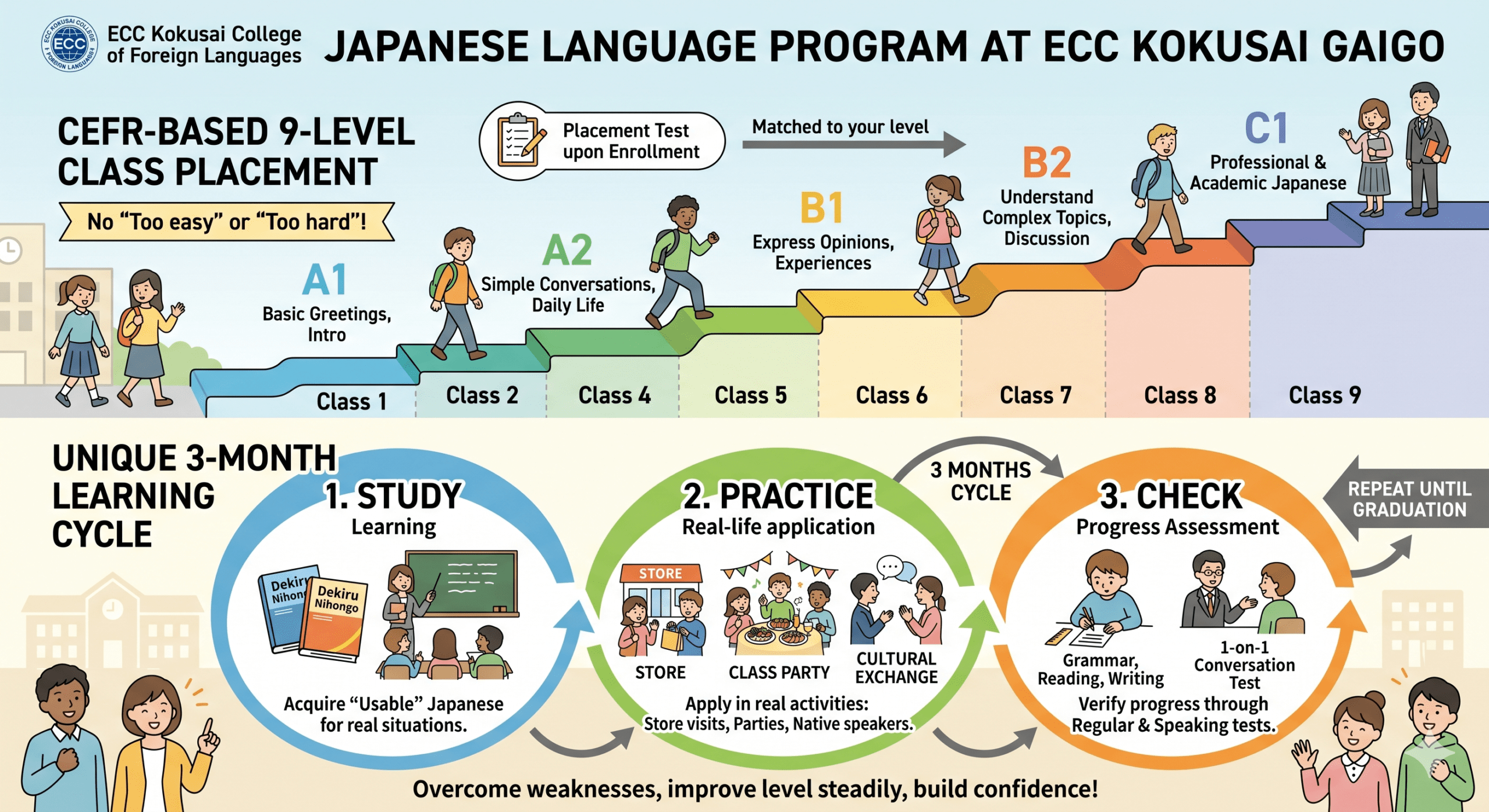
Class organization at ECC Kokusai College of Foreign Languages follows a nine-level system aligned with the Common European Framework of Reference for Languages (CEFR) (A1–C1). Since you’re placed in a class matching your level through a placement test upon enrollment, there’s no worry about classes being “too easy and boring” or “too difficult to follow.”
What’s particularly distinctive is the school’s unique “three-month learning cycle.”
- Learning: Acquire “practical Japanese” suited to various scenes and situations using the textbook “Dekiru Nihongo”
- Practice: Apply what you’ve learned through actual activities such as shopping at stores, class parties, and exchanges with Japanese guests
- Check: Confirm achievement level through regular tests (grammar, reading, writing) and conversation tests (one-on-one dialogue with teachers)
By repeating this cycle every three months and continuing until graduation, you can steadily level up while overcoming weak areas. This active learning-style teaching approach that emphasizes “enjoying while using” cultivates confidence and ability in many international students.
Feature ③ Learn Living Japanese! “Buddy Program” and Japanese Cultural Experiences
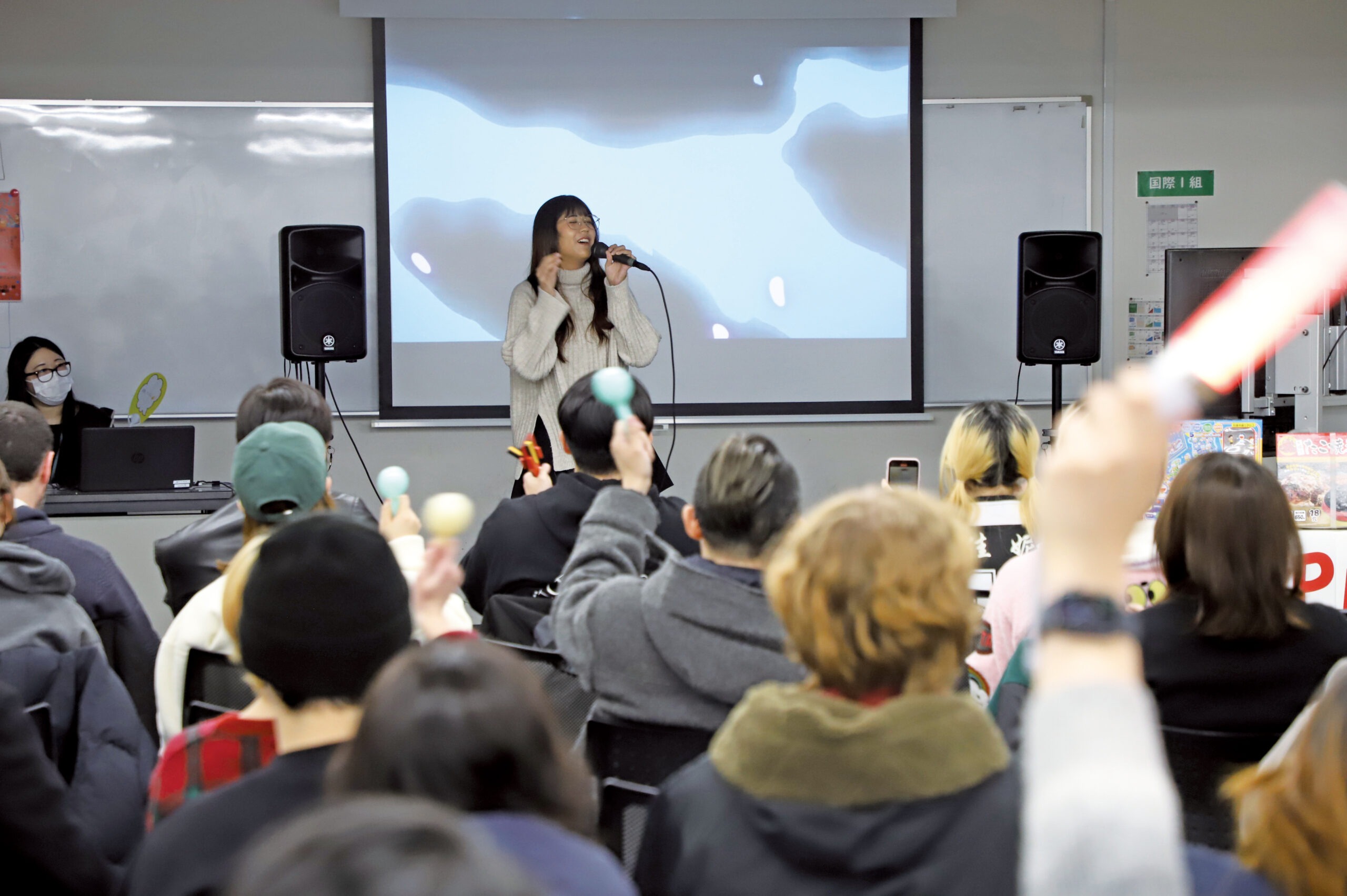
No matter how much you study in class, your ability won’t develop without opportunities to actually use Japanese. At ECC Kokusai College of Foreign Languages, abundant opportunities are provided to apply the Japanese you’ve learned in real life.
The “Buddy Program” is an international exchange program where approximately 2,280 Japanese students from Yamaguchi Gakuen and international students interact in small groups twice a week. While enjoying origami and games, Japanese conversation naturally emerges, and realizations accumulate like “This expression I learned in class—this is how it’s used in this situation!” Many students report that friendships formed here led to outings to Universal Studios Japan and daily communication.
Additionally, through Japanese cultural experience events (New Year’s calligraphy, tea ceremony, flower arrangement, yukata dressing, Japanese sweets making, etc.), you can physically experience the uniquely Japanese aesthetic sense and values behind the language. Cultural understanding of “why Japanese people use such expressions” deepens, making your Japanese language ability even richer.
Feature ④ Community Engagement Activities That Develop Human Skills Through Regional Exchange
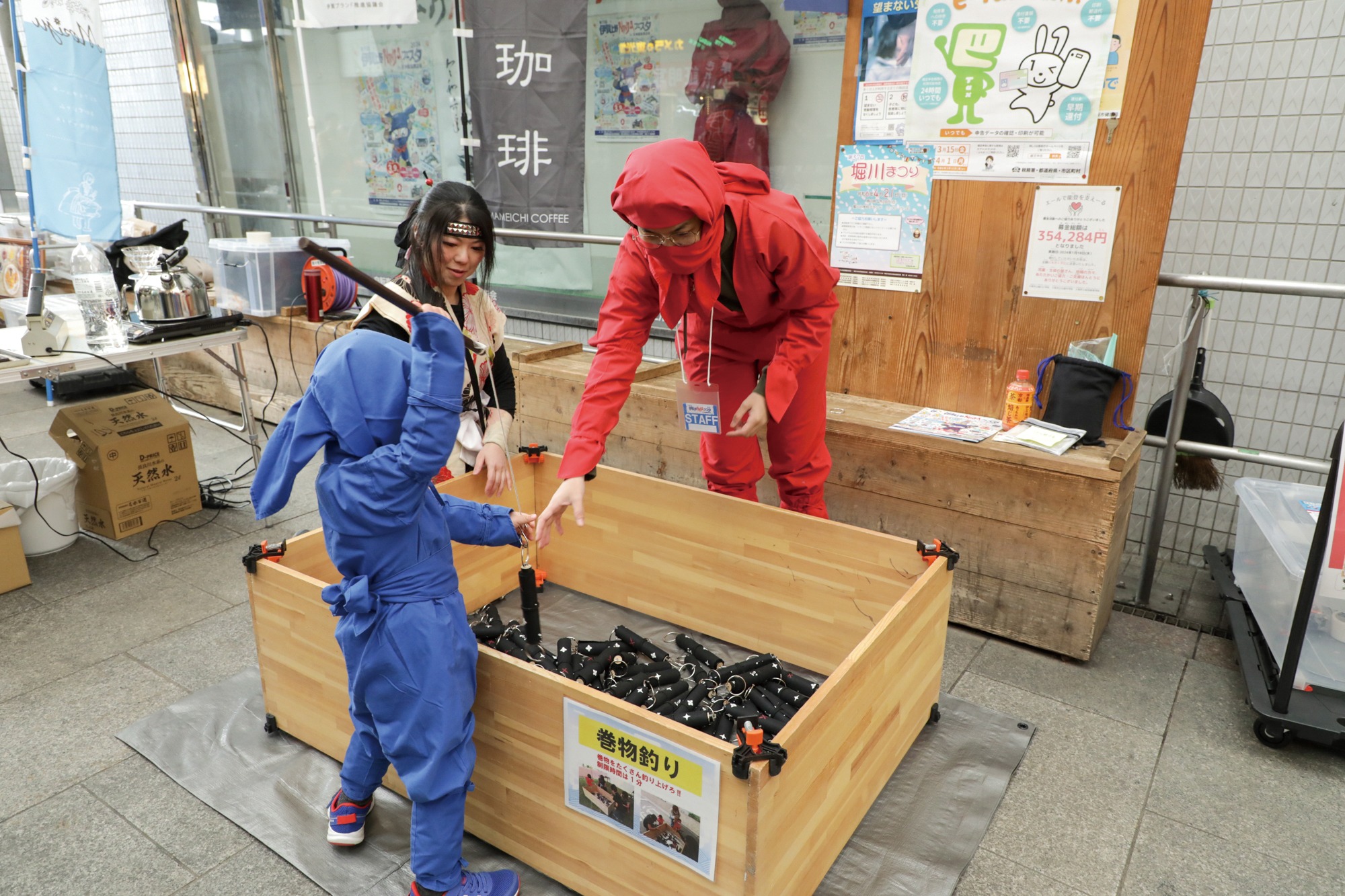
At ECC Kokusai College of Foreign Languages, “service learning and community contribution activities” that give back to society the knowledge and Japanese language skills acquired in class are also actively implemented.
Major events students participate in include the “Nakazakicho Candle Night” created with local residents, the “Omotenashi Squad” at “OSAKA Hikari no Renaissance,” a winter tradition in Osaka, operational staff for the “Osaka Castle Triathlon International Competition,” the “Honjo Mochi-tsuki Taikai,” and “town guidance for foreign and Japanese tourists” in Umeda.
These activities involving direct communication with local people provide real Japanese language experience unavailable in the classroom, while also serving as valuable opportunities to develop “human skills” such as cooperation, responsibility, and a spirit of challenge.
Feature ⑤ Abundant Opportunities for Presenting Results, Including Speech Contests

At ECC Kokusai College of Foreign Languages, multiple opportunities are provided to demonstrate daily learning achievements.
- Speech Contest: Once a year, representatives from each class give Japanese speeches on themes they want to convey. A unified occasion where entire classes support their representatives.
- Global Education Awards (GEA): A presentation competition for all Yamaguchi Gakuen students. Present your experiences and thoughts in Japanese on the theme of contributing to global society.
- Oratorical Contest: Held annually for the purpose of scholarships for foreign students and enrichment of Japanese language education. ECC Kokusai College of Foreign Languages students have won excellence awards at national competitions.
Through these occasions, “the ability to communicate in Japanese,” “the ability to organize logically,” and “the ability to speak confidently in front of people” are polished, deepening students’ confidence in Japanese.
Feature ⑶ Full Support for Advancement and Employment! Comprehensive Guidance and JLPT/EJU Preparation
A major strength is not only polishing Japanese language skills but also providing comprehensive support to achieve “advancement and employment” goals.
For those hoping to advance, one-on-one guidance by faculty and staged advancement guidance (choosing a major, statement of purpose, interview preparation, etc.) from May to September are provided. For those hoping for employment, résumé correction, manner training, and interview preparation are covered through employment guidance and individual consultations to support job offers in desired industries and occupations.
Additionally, preparation for JLPT (Japanese Language Proficiency Test) “N1–N3” and EJU (Examination for Japanese University Admission) is available on-demand or in-person. Consistent support is provided from Japanese language acquisition to career realization.
3. Course Introduction by Objective (Long-term and Short-term Programs)

At ECC Kokusai College of Foreign Languages, multiple courses (long-term and short-term) are available to flexibly match each international student’s goals. Here, let’s look in detail at which goals each course suits.
“Advancement Program” for Those Aiming for Japanese Universities and Vocational Schools
The “Advancement Program” is a course specialized for international students aiming to advance to higher education institutions such as Japanese universities, graduate schools, and vocational schools. Depending on enrollment timing, you can choose from two periods: 1 year and 6 months (October enrollment) or 2 years (April enrollment).
The greatest feature of this course is that you can thoroughly learn advanced “academic Japanese” directly connected to learning at your advancement destination. Beyond merely acquiring everyday conversation, you’ll solidly acquire “the ability to listen to and understand lectures (academic listening)” and “the ability to read and comprehend academic materials (academic reading)” essential at universities and graduate schools, as well as “the ability to create logical reports (academic writing).”
Additionally, “learning aimed at passing JLPT N1″ essential for studying at Japanese higher education institutions is naturally included, along with advancement preparation for universities and vocational schools, EJU preparation, and graduate school preparation incorporated into the curriculum. Furthermore, through “project work” that polishes the ability to collaborate in Japanese through group work, you’ll comprehensively develop “skills to logically convey your own thoughts and deeply understand others’ thoughts” truly needed at advancement destinations. This is a course we can confidently recommend to those with high aspirations to become active as global human resources in the future.
“Career Design Program” for Those Aiming for Employment in Japan
For those with clear goals of finding employment at Japanese companies or becoming active on the front lines of global society in the future, the “Career Design Program” is optimal. This course allows you to choose from three study periods—1 year (April/October enrollment), 1 year and 6 months (April/October enrollment), or 2 years (April/October enrollment)—according to your current Japanese language level and goals.
The greatest feature of this course is that you can comprehensively acquire skills essential for actually working in Japanese society, not just language learning. Through “Career Design” classes incorporated into the curriculum, you can thoroughly learn the basics of “Japanese-style job hunting,” which has high hurdles for foreigners, from how to write résumés and entry sheets to interview preparation. Additionally, by deepening understanding of Japanese culture and social systems through “Japanese Affairs” classes, you’ll develop practical “Japanese language proficiency” for building smooth interpersonal relationships with those around you and achieving self-realization in a multicultural society.
This course, which allows simultaneous acquisition of “advanced Japanese language ability applicable in business settings” and “understanding of Japanese social rules and values,” will be a very reassuring choice for international students wanting to succeed in job hunting in Japan.




“Short-term Program” for Working Holiday and Short-term Stays
For those staying in Japan on a working holiday or holding short-stay visas, permanent resident visas, etc., who “want to intensively study Japanese in a short period,” the “Short-term Program” is recommended.
This course can be taken for periods of 3 months (45 class days) or 6 months (90 class days). The greatest advantage is that student visa application procedures are unnecessary, making procedures from application to enrollment very simple and smooth.
Enrollment periods are available four times a year—“January, April, June, and October”—allowing you to flexibly start learning according to your stay schedule. Through a placement test conducted after arrival in Japan, you’ll enter a class perfectly matching your level and receive full-scale Japanese language education in the same environment as long-term program international students.
This course is optimal not only for those who “want to study for just a short period first” but also allows you to apply for the long-term program and continue learning if you feel “I want to study more seriously” after taking the course. It’s perfect for those wanting to efficiently acquire practical Japanese language skills in a short period to enrich their life and activities in Japan.
4. Tuition

Understanding tuition is very important when planning to study abroad. Here’s a summary of estimated tuition at ECC Kokusai College of Foreign Languages.
Long-term Program Tuition
| Fee Item | Amount |
|---|---|
| Selection Fee (Student Visa Applicants Only) | 20,000 yen |
| Entrance Fee | 60,000 yen |
Tuition
If annual tuition is paid in a lump sum, a 20,000 yen reduction is applied compared to installment payment. The timing for the second installment payment of annual tuition is approximately 4 months after enrollment.
| Study Period | Tuition | Annual Lump Sum Tuition | Installment Tuition | ||
|---|---|---|---|---|---|
| 1st Payment | 2nd Payment | ||||
| 2-year Course | 1st Year | 840,000 yen | 820,000 yen | 420,000 yen | 420,000 yen |
| 2nd Year | 840,000 yen | 820,000 yen | 420,000 yen | 420,000 yen | |
| 1.5-year Course | 1st Year | 840,000 yen | 820,000 yen | 420,000 yen | 420,000 yen |
| 2nd Year (0.5 year portion) | 420,000 yen | 420,000 yen | 420,000 yen | – | |
| 1-year Course | 1st Year | 840,000 yen | 820,000 yen | 420,000 yen | 420,000 yen |
Other Fees (Per Academic Year)
| Study Period | School Event Fee | Living Safety Fee | ||
|---|---|---|---|---|
| Student Visa | Non-Student Visa | |||
| 2-year Course | 1st Year | 20,000 yen | 7,000 yen | 3,000 yen |
| 2nd Year | 20,000 yen | 7,000 yen | 3,000 yen | |
| 1.5-year Course | 1st Year | 20,000 yen | 7,000 yen | 3,000 yen |
| 2nd Year (0.5 year portion) | 10,000 yen | 5,000 yen | 3,000 yen | |
| 1-year Course | 1st Year | 20,000 yen | 7,000 yen | 3,000 yen |
Textbook fees are included in tuition (textbook fees for non-required online classes, etc. are at actual cost).
Short-term Program Tuition
| Period | Enrollment Application Fee | Tuition | School Event Fee | Living Safety Fee |
|---|---|---|---|---|
| 3 months (45 days) | 30,000 yen | 202,500 yen | 5,000 yen | 3,000 yen |
| 6 months (90 days) | 60,000 yen | 405,000 yen | 10,000 yen | 3,000 yen |
For the short-term program, textbook fees (approximately 20,000 yen) are charged separately at actual cost.
5. Full Support for Advancement and Employment in Japan! Overwhelming Achievement Record
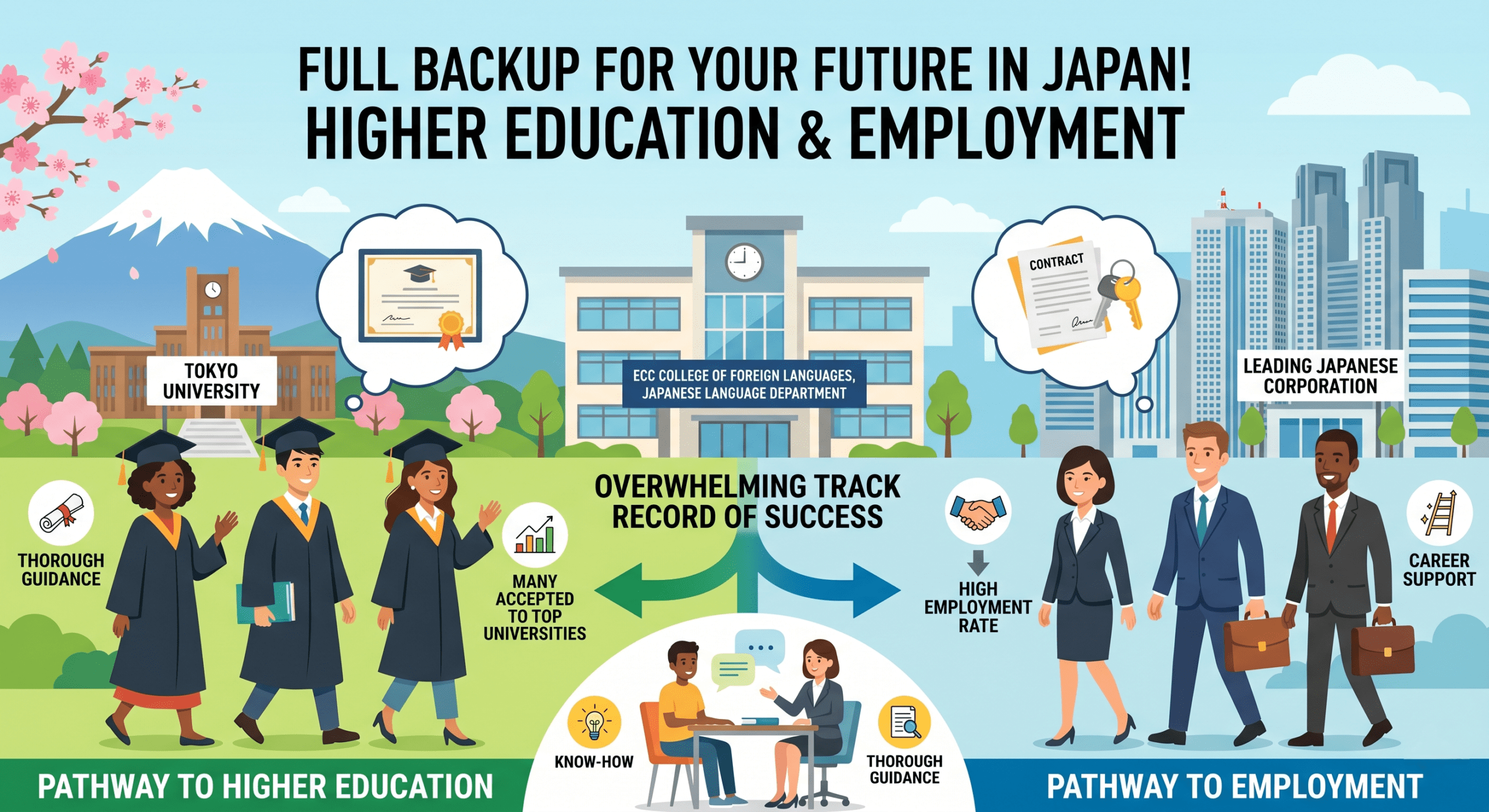
The true value of a comprehensive curriculum and learning environment is reflected in actual “results.” At ECC Kokusai College of Foreign Languages, thorough career guidance utilizing abundant expertise accumulated over many years guides numerous international students to their desired paths every year.
High Advancement Achievement to National/Public and Elite Private Universities
For international students aiming to advance to Japanese universities or graduate schools, advancement achievement to target schools is one of the most important criteria for choosing a Japanese language school. This school conducts careful one-on-one career guidance, and many international students have achieved acceptance to prestigious universities and graduate schools to date.
Looking at data for graduates from 2009 to March 2024 (*cumulative results for Japanese Language Department and International Communication Department), the overwhelming acceptance achievement is clear at a glance.
| Category | Number Accepted | Major Acceptances (Partial List) |
|---|---|---|
| National/Public Universities | 315 students | Osaka University, Kyoto University, Kobe University, Hokkaido University, Tokyo Institute of Technology, Nagoya University, etc. |
| Elite Private Universities | 213 students | Waseda University, Keio University, Doshisha University, Kansai University, Ritsumeikan University, Sophia University, etc. |
| General Private Universities | 1,369 students | Kindai University, Ryukoku University, Kyoto Sangyo University, Kobe Gakuin University, etc. |
| National/Public Graduate Schools | 229 students | Osaka University Graduate School, University of Tokyo Graduate School, Kyoto University Graduate School, Tohoku University Graduate School, etc. |
| Elite Private Graduate Schools | 152 students | Waseda University Graduate School, Keio University Graduate School, Doshisha University Graduate School, etc. |
| General Private Graduate Schools | 127 students | Osaka University of Economics Graduate School, St. Andrew’s University Graduate School, etc. |
The reason such high achievement can be continuously produced is the comprehensive support system that addresses each international student’s wishes individually. Regular advancement guidance sessions and advancement information sessions are held on campus, and detailed “acceptance reports” left by seniors can be freely viewed. An environment that powerfully supports everything needed for acceptance—from how to write statements of purpose to interview preparation—provides a very significant advantage for examinees.
JLPT/EJU Preparation and Higher Education Guidance
Qualification exam results are also noteworthy.
- JLPT N1 passers: 175 students (cumulative results 2020–2023)
- EJU Japanese subject 300+ scorers: 139 students (cumulative results 2020–2023, excluding composition)
Supporting these results is a comprehensive support system for JLPT preparation (on-demand, etc. for N1–N3) and EJU preparation (on-demand or in-person) in addition to regular classes. Advancement guidance is conducted one-on-one by faculty, with individual guidance toward target school acceptance from “considering majors” in May to “interview preparation” in September. The advancement consultation room where you can reference seniors’ detailed acceptance reports is also a reassuring ally for examinees.
Employment Offer Achievement at Japanese Companies
For students aiming for employment in Japan, careful employment guidance is conducted covering résumé and entry sheet correction, self-analysis, manner training, and interview preparation. There are employment offer achievements in diverse industries including hotels/tourism, IT, games, food service, and manufacturing, with some academic years achieving a 100% domestic employment offer rate. This is also due to the powerful career path established where, in addition to acquiring advanced language skills in the Japanese Language Department of ECC Kokusai College of Foreign Languages, students study specialized skills in business, IT, games, etc. at vocational schools in the same Yamaguchi Gakuen group (such as ECC College of Computer & Multimedia and ECC Kokusai College of Foreign Languages (Specialized Curriculum)) before aiming for employment in Japan. A system is in place where the school fully supports the dream of “working in Japan.”
| Industry | Number Employed |
|---|---|
| IT | 156 students |
| Business | 114 students |
| Hotels/Tourism | 41 students |
| Games/CG | 33 students |
| Trade/Distribution | 22 students |
| Web/Design | 14 students |
6. Optimal Learning Environment and Reliable International Student Support

No matter how excellent the curriculum, you can’t demonstrate your true abilities if the environment you attend daily isn’t well-equipped. At ECC Kokusai College of Foreign Languages, no expense is spared in investing in the “learning environment” itself. From comprehensive facilities and equipment to school events and daily life support, a system is in place where international students can concentrate on Japanese language acquisition with peace of mind.
Campus Equipped with Top-Level Facilities
-scaled.jpg)
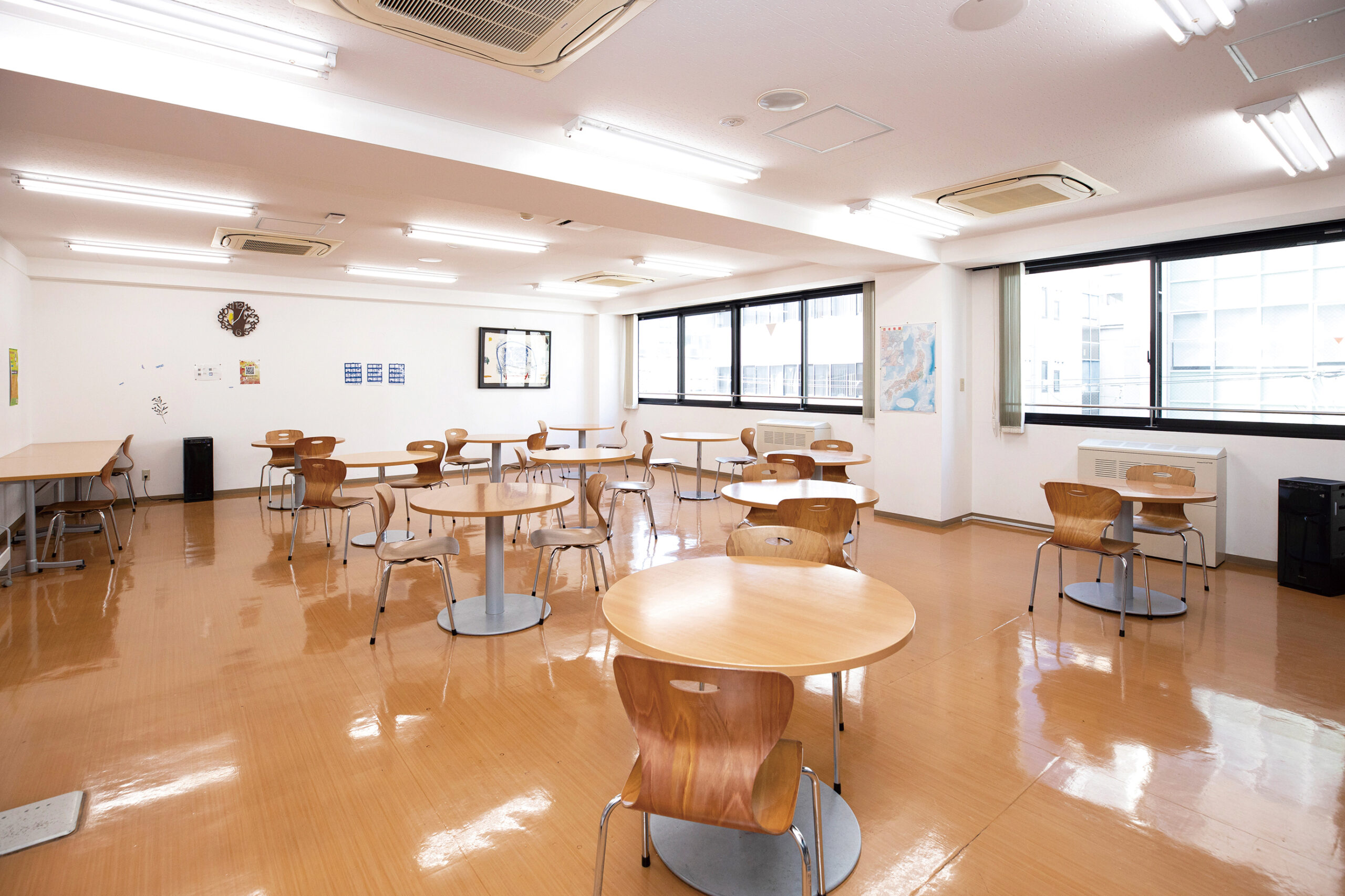

The ECC Kokusai College of Foreign Languages campus is a six-story building in a prime location approximately 10 minutes on foot from JR Osaka Station. A clean, well-ventilated entrance warmly welcomes international students. The entire building is equipped with Wi-Fi throughout, allowing free internet connection anywhere for comfortable completion of class preparation, review, and information gathering.
Classrooms where you attend daily classes are designed for small-group, level-based class organization. Always kept clean, each classroom is equipped with the latest air purifiers and the latest projectors. Using projectors enables dynamic lessons with video and slides, and you can learn real Japanese expressions while projecting actual TV news and newspaper articles on screen.
Time outside class is also fulfilling. The Language Center in the entrance has computers with constant internet connection available for free use. It’s utilized as a place to research points you didn’t understand in class at your own pace or deepen self-study of Japanese.
Particularly noteworthy is the existence of “ECC Japan Plaza.” A dedicated space for international students and Japanese students to interact and deeply learn about Japanese culture, featuring modern, stylish Japanese-style lighting with Katsushika Hokusai paintings as focal points. An environment where you can encounter “living Japanese” even outside class is naturally incorporated into campus.
The Academic Counseling Room is stocked with detailed success reports from senior students, and regular academic guidance sessions are also held here. The Student Lounge is fully equipped with vending machines and microwaves, providing a space where you can relax with your peers.
Fun Seasonal School Events

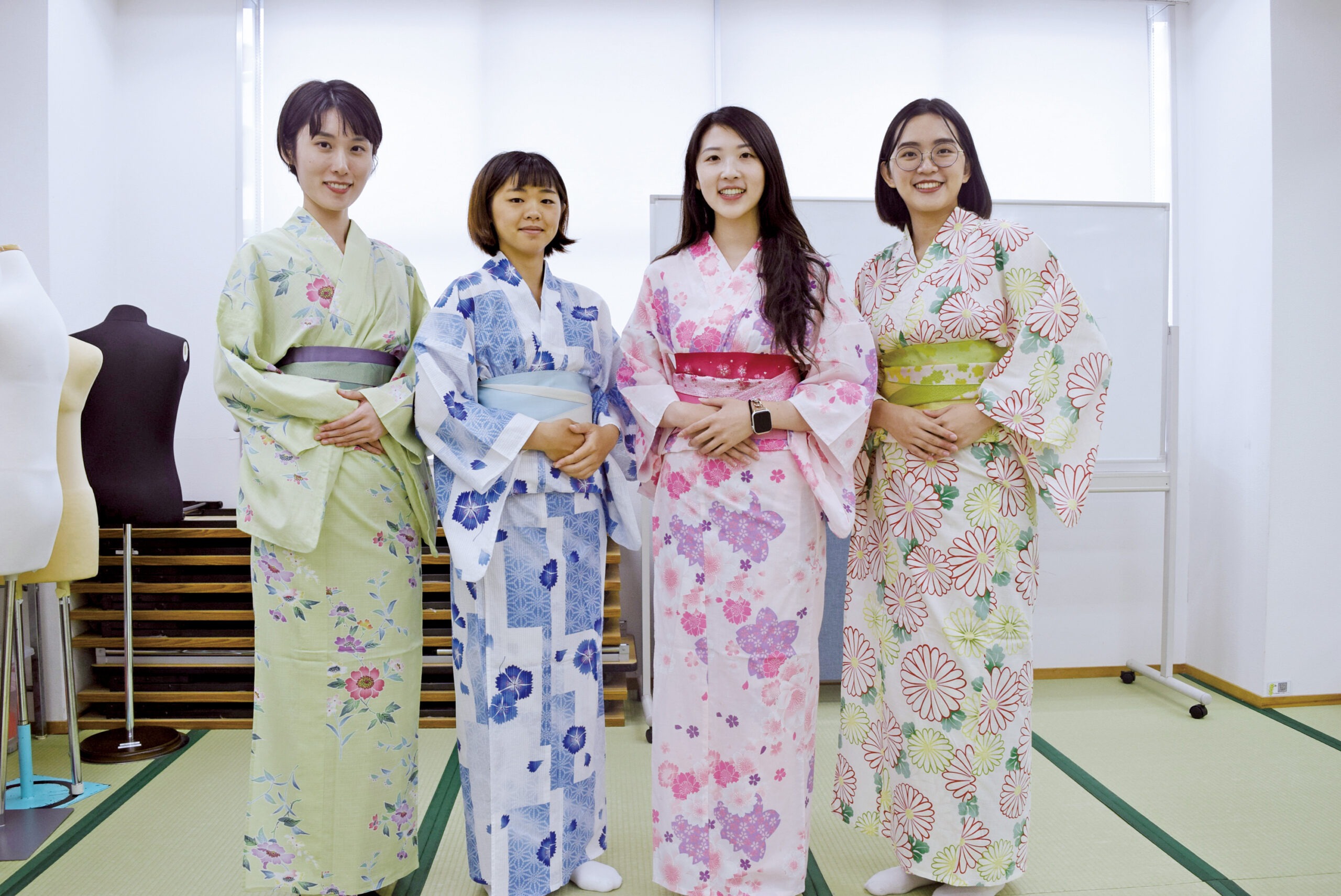
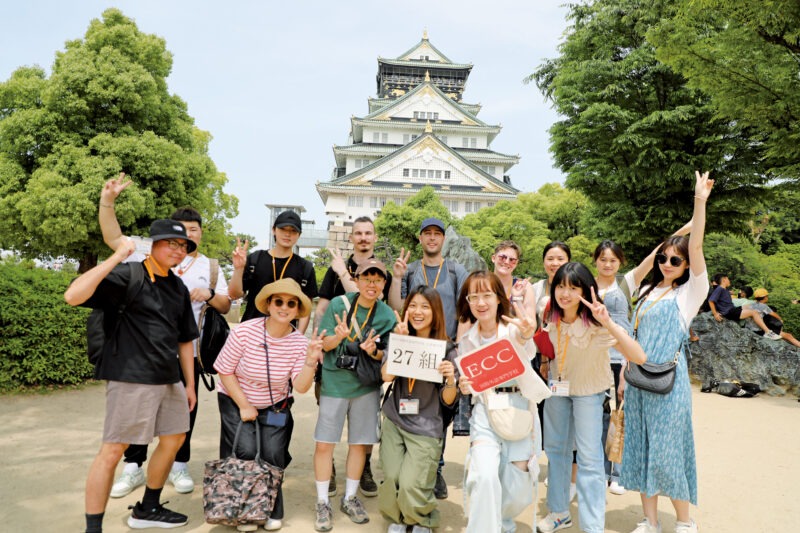
To enjoy a fulfilling life as an international student, it’s essential to have time to refresh and have fun with classmates, not just focus on daily studies. At ECC Kokusai College of Foreign Languages, there are plenty of school events throughout the year where both international and Japanese students can come together across nationalities and courses to have a great time.
For example, in the summer, the school hold the “Yukata Festival” and “Yo-yo Fishing Tournament,” where you can experience the atmosphere of a traditional Japanese festival. Additionally, the calendar is packed with exciting events like the “Speech Contest,” where students showcase their learning progress in front of a large audience, and the “Table Tennis Tournament,” featuring heated matches. From autumn to winter, various seasonal events color campus life, including “Halloween” with creative costumes, the “Ekiden Relay Race” where teams run together, and the “Global Festival” where students share dishes from their home countries.
Stepping out of the classroom to participate in various events not only creates lifelong memories but also provides an excellent opportunity to communicate naturally with Japanese students and international students from different backgrounds. The strong bonds formed through school events will make your days in Japan richer and more fruitful.
Multilingual Staff and Support for Housing and Part-time Jobs
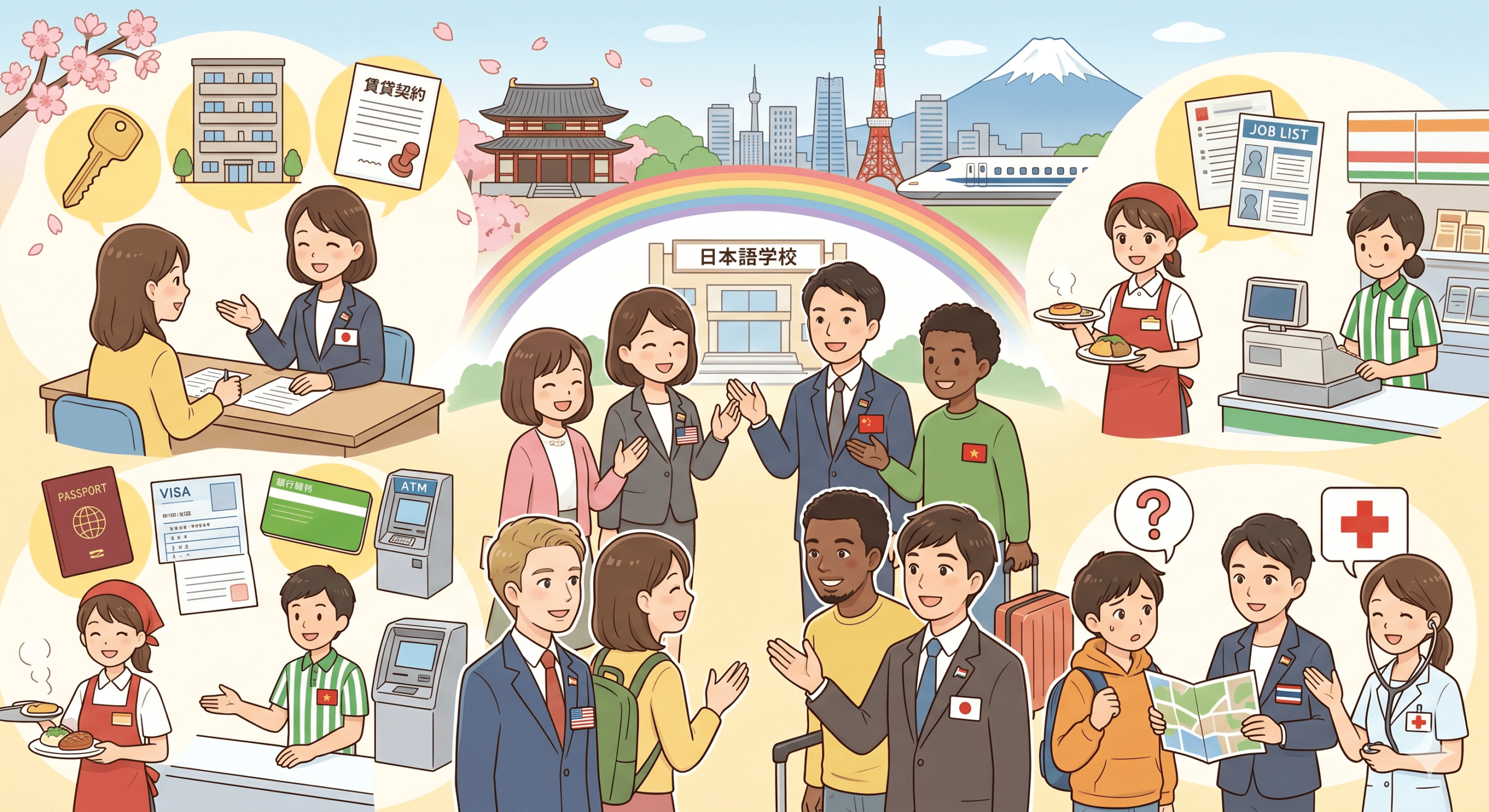
For international students starting life in Japan for the first time, language barriers and daily life anxieties are inevitable. The Japanese Language Department at ECC Kokusai College of Foreign Languages provides a comprehensive support system for both academic studies and general daily life.
The presence of multilingual staff is particularly reassuring. The administrative office has staff who speak multiple languages, including English, Chinese, Korean, Vietnamese, and Thai, so you can receive support in your native language even in situations where it’s difficult to consult in Japanese. They provide kind and helpful assistance for all aspects of school life, including enrollment procedures, residency status, and daily life issues.
Regarding housing, the school can provide referrals to affiliated student dormitories and apartments. Since they introduce properties that balance safety and price, the effort and anxiety of searching for a room on your own are significantly reduced.
For foreigners looking for affordable rental properties in Tokyo or Osaka
, please be sure to check out properties from “Xross House
.” You can choose your ideal home from a variety of options, including furnished share houses and studio apartments!

For more detailed information about Xross House, please see the article below. If you need support when renting a Xross House property, please feel free to contact us.

Additionally, the school provides information on part-time jobs to support the financial independence of international students. Guidance is provided on how to find jobs within the scope of a student visa and important points to note, helping students find a way to balance academics and work while enriching their life in Japan. Using Japanese in a real work environment also contributes greatly to improving language skills by providing communication experiences that cannot be gained in a classroom.

7. Voices of Graduates

What kind of experiences did graduates who actually studied at the Japanese Language Department of ECC Kokusai College of Foreign Languages have? Here are some real voices from graduates around the world.

“A place of learning that led me to realize my dream of entering university”
As an ordinary high school student from China, I gained the courage and knowledge at ECC Kokusai to realize my dream of entering a medical university. Thanks to the effective teaching methods, I was able to build a solid foundation in a short period. The teachers stay close to each student and provide careful support not only in studies but also in daily life. With many extracurricular activities and opportunities for interaction, I was able to learn with peace of mind without feeling anxious about life in Japan.

“I passed the graduate school entrance exam thanks to the support of my teachers”
During the graduate school application process, the deadline was earlier than I imagined, and I struggled with the need to prepare documents quickly. The career guidance teachers at ECC Kokusai helped me so much by proofreading my documents and research plans. I believe I was able to pass this time because of the teachers’ guidance.

“Realizing the dream of working in my admired Japan using Japanese. Every day feels rewarding.”
I studied Japanese because I admired my father and brother, and I enrolled with the goal of finding a job in Japan. I progressed from the Japanese Language Department to the International Business Course within ECC Kokusai College of Foreign Languages, where I acquired business knowledge and manners through classes and internships. Currently, I work as a process engineer in the chemical products division of a company expanding overseas, where I am responsible for analyzing the causes of defects, inspecting products, and also instructing and interpreting for technical interns. Supported by those around me, I am living rewarding and fulfilling days.
8. Admission Procedures

Finally, we will explain the important points regarding “Admission Procedures” that you should know when considering enrollment in the Japanese Language Department of ECC Kokusai College of Foreign Languages.
Total Capacity
The total capacity of the Japanese Language Department at ECC Kokusai College of Foreign Languages is 640 students (the recruitment capacity for long-term courses is 470). Applications will close as soon as the capacity is reached. Because it is a popular school, if you put it off thinking “I’ll do it later,” you might find that recruitment has already ended. Early information gathering and preparation are the shortcuts to admission.
Application Period
The enrollment timing and application periods differ between long-term and short-term courses. For long-term courses, please be very careful as the application period varies significantly depending on whether you need to apply for a student visa.
Long-term Course (1-year, 1.5-year, 2-year courses)
| Course Name | Enrollment Timing | Target Applicants | Application Period |
|---|---|---|---|
| April Term | Student Visa Applicants | July to end of October | |
| Those who do not need to apply for a student visa | October of previous year to end of March | ||
| October Term | Student Visa Applicants | January to mid-May | |
| Those who do not need to apply for a student visa | April to end of September | ||
| January Term | Those who do not need to apply for a student visa (Holders of Temporary Visitor, Working Holiday, Dependent visas, etc.) | Until December 10 | |
| April Term | Until end of March | ||
| June Term | Until June 10 | ||
| October Term | Until end of September |
Since obtaining a student visa involves screening by the Immigration Services Agency and takes several months, you need to start the procedures more than six months before enrollment. Depending on the application deadline for the Immigration Services Agency, the application period may be even earlier, so we recommend contacting Japan Education Career (JEC) as soon as possible.
Short-term Course (3-month, 6-month courses)
Short-term courses have four enrollment periods per year (January, April, June, and October). The procedure is simple because a student visa application is not required, but since the recruitment periods may vary, please check with JEC in advance to see if you can take the course during your desired period.
Admission Eligibility
The main qualifications and conditions required for application are as follows:
Long-term Course (1-year, 1.5-year, 2-year courses)
- Must have completed (or be expected to complete) 12 years or more of school education in a foreign country, or have completed a secondary education course that qualifies for university entrance.
- Must be 18 years of age or older in principle.
- Must be able to lead an independent life as an international student after understanding the educational content of this school.
- Must be able to promise not to smoke within the campus and in the school’s neighborhood.
- Note that an interview may be conducted depending on nationality and background.
Short-term Course (3-month, 6-month courses)
Since visa application is not required, the conditions are relatively simple: “Must be 18 years of age or older in principle (enrollment may be possible even if this does not apply, provided the Department Head approves).”
Documents Required for Admission
Long-term Course (1-year, 1.5-year, 2-year courses)
Student Visa Applicants (Applicants)
| Document | Remarks |
|---|---|
| Application Form for Admission (School’s prescribed form) | Use the school’s prescribed form. Provided by JEC. Describe the reason for study specifically. |
| Graduation Certificate (Original) or Diploma (Original) from the last school attended | Graduates of Chinese universities must download and submit degree authentication from the Ministry of Education website. |
| 2 Photos (4cm x 3cm) | Taken within 6 months, front-facing, without a hat. Photo data must also be submitted. |
| Copy of Passport | — |
| Japanese Language Proficiency Certificate | Certificates and score reports for JLPT, J-TEST, NAT-TEST, J-cert, etc. *If a certificate cannot be provided, a certificate of 150 hours or more of Japanese language study. |
| Certificate of Employment | Only for those applicable |
| Certificate of Enrollment or Certificate of Expected Graduation | Only for those applicable. If you are in your final year and expected to graduate, submit a Certificate of Expected Graduation or have it stated in your Certificate of Enrollment. |
| Copy of Family Register for all family members or an original certificate in its place | — |
| Pledge (School’s prescribed form) | Must be signed and stamped by both the applicant and the financial sponsor. |
Documents prepared in a foreign language must have a Japanese translation attached.
Required Documents for Financial Sponsor
When an overseas resident sponsors expenses
| Document | Remarks |
|---|---|
| Letter of Financial Support (School’s prescribed form) | To be filled out by the sponsor. Specify the method of tuition payment and the amount/frequency of living expense remittances. |
| Certificate of Bank Balance | Latest version. Depending on the country, a copy of the bankbook is also acceptable. |
| Certificate of Employment | For self-employed or company owners, a corporate register, etc. |
| Tax Payment Certificate (or Income Certificate) | Most recent one stating the income amount. |
| Documents proving the relationship with the applicant | For the applicant and all family members. China: Copy of Hukou; Taiwan: All pages of the Family Register; Korea: Family Relationship Certificate. |
Documents prepared in a foreign language must have a Japanese translation attached.
When a resident in Japan (other than the applicant) sponsors expenses
| Document | Remarks |
|---|---|
| Letter of Financial Support (School’s prescribed form) | To be filled out by the sponsor. Specify the method of tuition payment and the amount/frequency of living expense remittances. |
| Resident Tax Payment Certificate | Must also specify the income amount. |
| Certificate of Bank Balance | Latest version. |
| Proof of Occupation | Company employee: Certificate of Employment / Company officer: Certified copy of company register / Self-employed: Business license (copy) |
| Certificate of Residence | Must list all members of the same household. |
| Documents proving the relationship with the applicant | One copy of the family register, resident registration, etc., from the home country. |
When the applicant themselves sponsors expenses
| Document | Remarks |
|---|---|
| Certificate of Bank Balance | From a bank, etc., in the applicant’s name. Documents proving the applicant’s assets. |
| Certificate of Employment | — |
| Tax Payment Certificate or Income Certificate | Most recent one stating the income amount. |
| Letter of Financial Support | Fill in only sections 2(1), (2), (3) and the name (signature). |
Documents prepared in a foreign language must have a Japanese translation attached.
When sponsoring expenses with a scholarship
| Document | Remarks |
|---|---|
| Certificate from the scholarship granting organization | Must clearly state the “grant amount” and “granting organization.” |
| Documents explaining the outline of the company/organization and documents similar to scholarship grant regulations | Only if the scholarship granting organization is a private company or organization. |
| Documents explaining the circumstances leading to the scholarship award | — |
| List of past international student recipients | Only if it can be submitted. |
Documents prepared in a foreign language must have a Japanese translation attached.
Those who do not need to apply for a student visa
- Application Form for Admission (School’s prescribed form)
- Graduation (or Expected Graduation) Certificate (Original) or Diploma (Original) from the last school attended
- 2 Photos (4cm x 3cm) (Taken within 6 months, front-facing, without a hat. Photo data must also be submitted.)
- Copy of Passport
- Pledge (School’s prescribed form)
- Copy of Residence Card
Short-term Course (3-month, 6-month courses)
- Application Form for Admission (School’s prescribed form)
- Pledge (School’s prescribed form)
- 1 Photo (4cm x 3cm) (Taken within 6 months, front-facing, without a hat. Photo data must also be submitted.)
- Copy of Passport
Flow Until Admission
The admission procedure for the Japanese Language Department of ECC Kokusai College of Foreign Languages differs significantly between “those who need to apply for a student visa” and “those who already have another visa and do not need to apply.” Please check the steps that apply to you.
Flow for Student Visa Applicants (Those obtaining a new student visa)
- STEP 1Prepare required documents and submit to Japan Education Career (JEC)
Fill in the necessary information in the application documents provided by JEC, gather all required documents, and submit them to JEC.
- STEP 2JEC confirms the application documents and submits to ECC Kokusai College of Foreign Languages
JEC will check the contents of the application documents and, if there are no problems, submit them to the ECC Kokusai College of Foreign Languages. The screening fee (20,000 yen) is paid at this time.
- STEP 3ECC Kokusai College of Foreign Languages confirms the application documents
The school will confirm the contents of the submitted documents. In some cases, additional documents may be requested.
- STEP 4Screening by the Immigration Services Agency (ECC Kokusai College of Foreign Languages applies on your behalf)
The school will apply for the COE to the Immigration Services Agency. During the screening period at the Immigration Services Agency, additional documents may be requested.
- STEP 5Issuance of the Certificate of Eligibility (COE) by the Immigration Services Agency (received by ECC Kokusai College of Foreign Languages)
If there are no problems, the COE will be issued and sent to the school.
- STEP 6Receipt of tuition invoice and payment
This is the timing to pay the enrollment fee and the initial tuition.
- STEP 7Issuance of COE and Admission Permit by ECC Kokusai College of Foreign Languages
The original COE and the Admission Permit will be sent from the school.
- STEP 8Apply for a visa at the Japanese Embassy or Consulate in your home country
Apply for a student visa at the Japanese Embassy in your home country.
- STEP 9Obtain student visa and book flights
Come to Japan after obtaining the visa.
- STEP 10Enrollment
After admission, class placement will be conducted according to Japanese language ability and learning objectives.
For those who do not need to apply for a student visa
For those who do not need a visa application, the procedure is simple, and the lead time from document submission to admission is shorter.
- STEP 1Prepare required documents and submit to Japan Education Career (JEC)
Fill in the necessary information in the application documents provided by JEC, gather all required documents, and submit them to JEC.
- STEP 2JEC confirms the application documents and submits to ECC Kokusai College of Foreign Languages
JEC will check the contents of the application documents and, if there are no problems, submit them to ECC Kokusai College of Foreign Languages.
- STEP 3ECC Kokusai College of Foreign Languages confirms the application documents
The school will confirm the contents of the submitted documents. In some cases, additional documents may be requested.
- STEP 4Receipt of tuition invoice and payment
This is the timing to pay the enrollment fee and the initial tuition.
- STEP 5Enrollment
After admission, class placement will be conducted according to Japanese language ability and learning objectives.
9. Frequently Asked Questions (FAQ)

- QWhat countries do the students come from?
- A
Students from over 42 countries worldwide are enrolled, including Asian countries such as China, Taiwan, Hong Kong, Macau, South Korea, Thailand, Vietnam, Myanmar, Malaysia, and Indonesia, as well as Canada, the USA, Brazil, Peru, Colombia, Italy, the UK, France, Switzerland, Sweden, and Denmark.
- QWhat is the class schedule like?
- A
Classes are held from Monday to Friday, with 5 periods a day. The class hours are 9:00 AM to 1:10 PM for the morning class and 1:40 PM to 5:50 PM for the afternoon class. Which class you will be in is determined by your Japanese language proficiency.
- QHow much does it cost to live in Japan?
- A
For a lifestyle centered on studying, the estimate is about 80,000 to 100,000 yen per month. The breakdown is 30,000 to 50,000 yen for housing, 25,000 to 35,000 yen for food, and miscellaneous expenses such as transportation and social activities. Note that a security deposit for housing will be required separately upon arrival in Japan.
- QI am worried about what happens if I get sick or injured.
- A
There are many hospitals near the school and dormitories, including some where English, Chinese, and Korean are spoken. The “Enrollment Guide” (available in various languages) distributed at the orientation upon admission contains information on major nearby hospitals, and the administrative office also provides guidance. Regarding medical expenses, all students on a student visa must join the National Health Insurance (the enrollment method will be explained after arrival), which covers 70% of medical costs, meaning you only pay 30% out of pocket. For those on a temporary visitor visa, we recommend joining overseas travel insurance in your home country before coming to Japan, as you cannot join the National Health Insurance.
- QHow much savings balance is required to study abroad?
- A
The required bank balance is roughly the “tuition + living expenses for the study period” minus the “difference between the financial sponsor’s income and expenditures.” For example, if you study for 2 years, the total of approximately 3.62 million yen (approx. 1.7 million yen for tuition + approx. 1.92 million yen for living expenses at 80,000 yen x 24 months) minus the financial sponsor’s annual surplus income would be the required bank balance. It is safer not to include part-time job income in the calculation. Also, if you plan to go on to university after graduation, you need to consider those tuition and living expenses as well.
- QHow much income does the financial sponsor need to have in order to study abroad?
- A
The required income amount cannot be generalized as living standards vary by country, but for example, in China, an annual income of 100,000 yuan (approx. 1.5 million yen) or more is considered one guideline. The balance of the financial sponsor’s bank balance, income, and expenditures will be comprehensively reviewed. Please contact JEC for detailed conditions.
- QWhat level of academic background is required?
- A
Since ECC Kokusai College of Foreign Languages is a vocational college (higher education institution), the target for admission is those who have graduated from high school or higher (in principle, completed 12 years of education). However, for those from countries with an education system of less than 12 years or if there is a valid reason, admission may be granted, so please contact us first.
- QIs there an age limit?
- A
In principle, those 18 years of age or older are eligible for admission. However, there are exceptions for those under 18 who have completed secondary education, so please contact us. There is no upper age limit, but for those who have been out of school for more than 5 years, the reason for study, their background after graduation, and the validity of their reason for wanting to study in Japan will be more strictly reviewed.
- QCan I enroll even if I cannot speak Japanese at all?
- A
No, in principle, for long-term courses, you need Japanese language proficiency equivalent to JLPT N5 or higher at the time of application, or a study history of 150 hours or more. This is also a screening requirement for a student visa and is essential to prevent life troubles after coming to Japan. Let’s start basic learning in your home country first.
Summary: For serious Japanese language study in Osaka, go to the ECC Kokusai College of Foreign Languages!
ECC Kokusai College of Foreign Languages is one of Osaka’s leading specialized Japanese language educational institutions, with an ideal learning environment for those who want to thoroughly acquire “practical Japanese.”
Let’s look back at the features introduced in this article.
- A highly reliable educational institution operated by Yamaguchi Gakuen, which has a tradition and track record of 42 years since its founding.
- An overwhelming amount of classes with 860 periods per year, which is more than 100 periods above the general standard.
- Steady progress with 9 levels of class placement based on CEFR and a unique 3-month learning cycle.
- Acquisition of living Japanese and a global mindset through the Buddy Program and Japanese culture experiences.
- Development of communication skills and personal character through service learning and community contribution activities.
- Generous support from homeroom teachers among 132 Japanese language instructors, along with comprehensive academic and career guidance.
- A brilliant track record of progression to higher education, with over 315 students entering national and public universities, 213 entering prestigious private universities, and 229 entering graduate schools.
- Career options not found in other schools, such as the internal progression system to the three schools within Yamaguchi Gakuen (with a full waiver of the enrollment fee).
- Highest standard campus facilities, including Wi-Fi throughout the building, the latest projectors, and the ECC Japan Plaza.
- Comprehensive life support through multilingual staff, student dormitory referrals, and part-time job information.
- Scheduled to start a new curriculum as a “Certified Japanese Language Educational Institution” from April 2027 (application pending).
Whether you aim to enter a university, graduate school, or vocational college in Japan, or want to carve out a career utilizing Japanese, ECC Kokusai College of Foreign Languages is an ideal choice. Why not start your life-changing Japanese language study in the vibrant city of Umeda, Osaka, with peers from 42 countries around the world?
If you wish to enroll in the ECC Kokusai College of Foreign Languages, please contact Japan Education Career using one of the following methods.
- Email: info@jpeducareer.com
- WhatsApp: +81 70 9631 4036
- Inquiry Form: Please scroll down for the inquiry form.
We will support your admission procedure for free!