This post is also available in:
 日本語
日本語  Türkçe
※この記事内にはプロモーションが含まれています。
For foreigners living in Japan, the initial costs of renting an apartment can be a significant financial burden. With security deposits, key money, broker fees, and other charges that can amount to several months’ worth of rent, scraping together that much money upfront can be challenging. The key to finding affordable rental properties in Japan as a foreigner is minimizing these initial costs.
This article explains the initial costs involved in renting apartments in Japan and introduces methods for keeping these expenses low. We’ll also explore “Xross House,” a service that provides affordable rental properties accessible to foreigners with low initial costs. For foreigners seeking inexpensive yet comfortable accommodations, this article will serve as a valuable resource.
- Detailed breakdown of rental property initial costs
- Methods for foreigners to minimize rental initial costs
- Features of “Xross House” – affordable rental properties accessible to foreigners
- Initial Costs for Rental Properties
- How Foreigners Can Minimize Rental Initial Costs
- Xross House: Affordable Rental Properties for Foreigners
- Summary
Initial Costs for Rental Properties

When renting an apartment, initial costs are unavoidable. These costs include security deposits, key money, broker fees, and other charges that must be paid upfront to secure your rental. Let’s break down these initial costs for foreigners planning to rent in Japan.
What Are Initial Costs?
Initial costs refer to the upfront fees paid when renting a property. Specifically, these include security deposits (shikikin), key money (reikin), broker fees, prorated rent, advance rent payments, fire insurance premiums, guarantee fees, and key replacement costs. These initial expenses occur during the rental application process and contract signing, making them essential for any rental agreement.
The amount and breakdown of initial costs vary by property and location, but typically require several months’ worth of rent. By paying these initial costs, tenants demonstrate their reliability and financial stability to property owners and real estate companies, who use these funds to cover property maintenance expenses and potential risks. While initial costs can be a substantial burden, proper planning and cost-saving strategies can help reduce this financial impact.
Breakdown of Initial Costs During Rental Contracts
Here’s the typical breakdown of initial costs:
Security Deposit (Shikikin)
The security deposit is a type of guarantee payment when renting a property. It covers costs for restoring the property to its original condition upon move-out and any unpaid rent or other debts. Generally set at 1-3 months’ rent depending on the property and location, the security deposit is paid in full upon move-in. If tenants properly maintain the property during their lease, repair any damage upon move-out, and fulfill all rent and debt obligations, the full amount is typically returned. However, if there is any damage or unpaid rent, the cost will be deducted from the deposit, and the remaining amount will be returned.
Key Money (Reikin)
Key money is a payment expressing gratitude to the landlord, typically equivalent to 1-2 months’ rent. Unlike security deposits, key money is generally non-refundable. Once paid, key money belongs to the landlord and won’t be returned upon contract termination or move-out. Therefore, tenants cannot request key money refunds during the lease period or upon moving out. The presence and amount of key money varies by property and location, so it’s important to confirm this before signing a contract.
Broker Fee (Chukai Tesuryo)
Broker fees are charges for real estate companies’ intermediary services during rental contracts. Generally paid by both landlords and tenants upon contract signing, these fees compensate real estate companies for property introductions and contract procedures. While typically equivalent to one month’s rent, amounts vary by property, location, and real estate company. Broker fees are usually paid in full when the rental contract is established and are not refunded during the lease period or upon move-out. Since it is charged as a commission for the real estate company, the brokerage fee is generally paid by both the landlord and the tenant. However, in some properties or areas, the tenant may be required to pay the full amount.
Prorated Rent (Hiwari Yachin)
Prorated rent applies when contract start or end dates fall mid-month. It’s calculated by dividing monthly rent by the number of days in that month, then multiplying by actual contract days. For example, if a contract starts mid-month, rent is calculated for the remaining days of that month. Similarly, if termination occurs mid-month, rent for the remaining days is deducted. Prorated rent is particularly important for non-fixed-term contracts or when move-in dates aren’t set for the beginning of the month.
Advance Rent Payment
This involves paying the following month’s rent at contract signing. Most rental properties adopt this system, and it’s typically included in initial costs.
Fire Insurance Premium
This insurance covers building and furniture damage from natural disasters after moving in. While amounts vary by property and contract conditions, it’s typically set at around 20,000 yen for two years. Though often specified by real estate companies, tenants can choose their own fire insurance.
Guarantee Fee (Hosho-ryo)
Guarantee fees are paid to guarantee companies to cover potential rent defaults. Usually equivalent to half a month to one month’s rent, some contracts require renewal fees every one or two years.
Key Replacement Cost
This fee covers creating new keys when moving into a rental property. Rather than using keys from previous tenants, new keys are made for each new tenant. Tenants bear this cost, which is separate from security deposits and key money. Key replacement costs vary by property and real estate company but typically range from several thousand to tens of thousands of yen. This fee is necessary to protect tenant safety and privacy, ensuring comfortable living for new residents.
Total Initial Costs Simulation (70,000 yen monthly rent)
Let’s simulate initial costs for a property with 70,000 yen monthly rent:
| Item | Amount (Estimate) |
|---|---|
| Security Deposit | 70,000 yen |
| Key Money | 70,000 yen |
| Broker Fee | 70,000 yen |
| Advance Rent | 70,000 yen |
| Fire Insurance | 15,000 yen |
| Key Replacement | 15,000 yen |
| Guarantee Fee | 35,000 yen |
| Total | 345,000 yen |
Additional Initial Costs
Beyond rental contract initial costs, you’ll also need moving expenses and furniture/appliance purchases.
Moving Costs
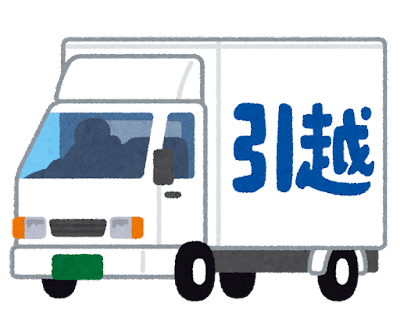
Moving costs include moving company fees, packing materials, and transportation expenses. Amounts vary based on distance, luggage volume, chosen moving company, and timing, typically ranging from tens of thousands to hundreds of thousands of yen. Additional services like packing or furniture assembly incur extra charges. Moving costs are essential for starting new life, so careful planning is important.
- Avoid busy seasons
- Use moving quote services (引越し屋) to compare multiple companies and choose the most affordable option
By using moving quote services (引越し屋) you can receive quotes from multiple moving companies. This makes it easier to compare prices and services, helping you choose a company that best fits your needs. We recommend taking advantage of this service.

Furniture and Appliance Costs
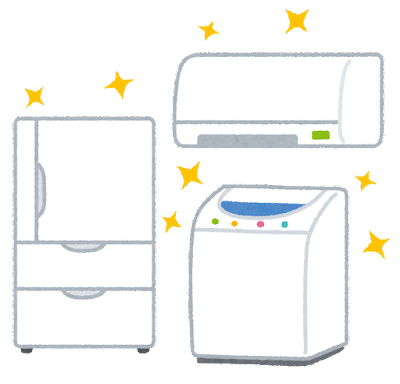
These costs cover necessary furniture and appliances for your new home, including beds, sofas, tables, chairs, refrigerators, washing machines, TVs, and air conditioners. Costs vary by item type, quality, and quantity, typically ranging from tens of thousands to hundreds of thousands of yen or more. New items cost more than used ones. When furnishing a new home, it’s important to budget and purchase strategically, considering functionality, durability, and cost-effectiveness.
How Foreigners Can Minimize Rental Initial Costs
When renting properties, initial costs are unavoidable. Here are four methods for foreigners to minimize rental initial costs:
Choose Properties with Zero Security Deposit and Key Money
To save on initial contract costs, look for properties that waive security deposits and key money. Since these typically cost one month’s rent each, zero-deposit properties can save up to two months’ rent.
Consider Changing Your Moving Date to Save on Initial Costs
Adjusting your moving schedule can be a smart way to reduce initial expenses. By avoiding peak seasons in the real estate market, you may be able to find lower rent prices and reduced agency fees.
In Japan, January to March and September to October are considered peak moving seasons. During these times, demand is high, which often leads to increased rent and higher moving service fees. On the other hand, the real estate market tends to slow down between June and August. This off-season is a great time to look for an apartment, as demand is lower and costs are typically more manageable.
Planning your move for a weekday or at the beginning of the month—when fewer people are moving—can also help cut costs. By being flexible with your moving date, you can significantly reduce your initial expenses and make your relocation more affordable.
Choose Furnished Properties

Selecting furnished properties is a convenient way to reduce initial costs. These properties eliminate the need to purchase furniture and appliances, saving significant money. This is especially useful for those without existing furniture/appliances or temporary residents. Additionally, having pre-installed furniture and appliances reduces moving hassles and burdens. Since furniture and appliances vary by property, you can choose accommodations matching your preferences and lifestyle.
Choose Real Estate Companies with Low Broker Fees
Selecting real estate companies with low broker fees is important for reducing initial costs. Broker fees compensate real estate companies for intermediary services and are paid in full upon contract signing. Choosing companies with lower fees reduces initial costs and financial burden. While most companies charge one month’s rent, some offer services ranging from free to half-price. Besides low fees, choosing trustworthy companies is important. Research reviews and reputation to select reliable companies for smooth contract processes and post-move-in support.
Xross House: Affordable Rental Properties for Foreigners

Xross House provides affordable rental properties that foreigners can move into with confidence. Supporting 10 languages, they help overcome language barriers for smooth move-in procedures. With reduced initial costs and furnished options, excellent locations, and diverse room types, they accommodate various lifestyles. They also offer web-only contracts requiring no store visits and free property transfer services, prioritizing tenant convenience. This is an ideal choice for foreigners seeking comfortable, secure living.
Why Foreigners Choose Cross House
Here are eight reasons why foreigners choose Xross House:
Multilingual Support: 10-Language Move-in Assistance

Xross House provides support in 10 languages to meet diverse tenant needs: Japanese, English, Korean, Chinese, Taiwanese, Vietnamese, Myanmar, Nepali, Sinhala, and Indonesian. This allows foreigners to complete move-in procedures smoothly without language barriers. Language support covers not just contracts and procedures, but property tours and local information throughout daily life. This enables foreigners to start Japanese life with confidence, achieving smooth move-ins without communication anxiety.
Xross House‘s website also supports 12 languages.
Low Initial Costs
Xross House‘s low initial costs are a major reason foreigners choose them:
- Private rooms, semi-private, dormitory → Flat 30,000 yen
- Furnished apartments → Flat 50,000 yen
Affordable Rent
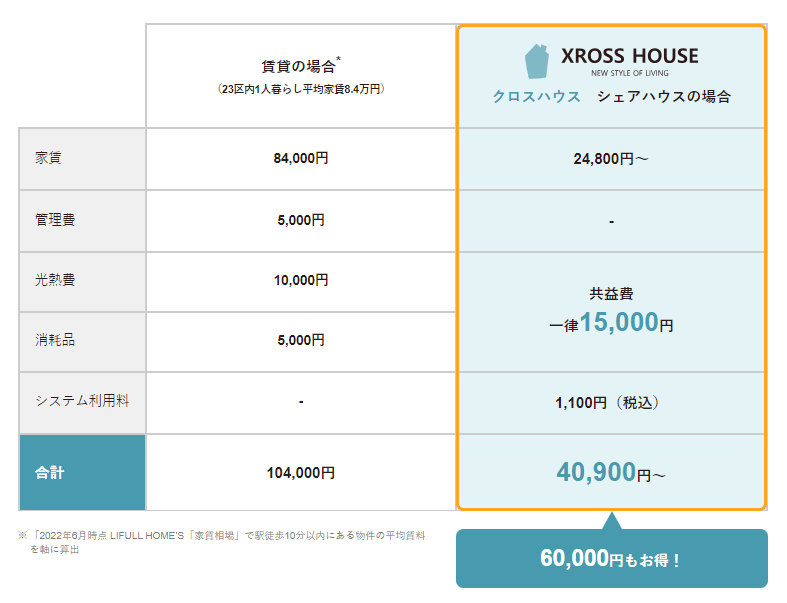
Xross House rent is very reasonable, allowing foreigners to live comfortably while keeping budgets low. Compared to surrounding properties, rent is set affordably, with abundant 40,000-50,000 yen rooms even in popular Tokyo areas.

Excellent Locations
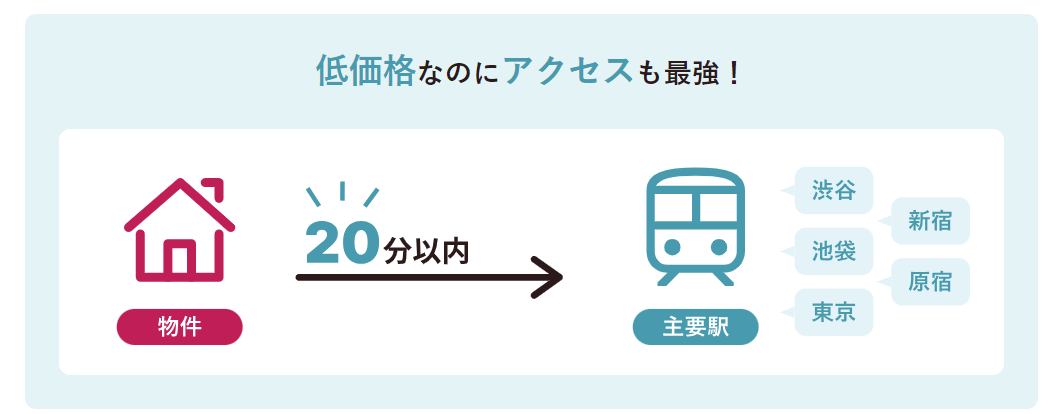
Good locations are crucial for foreigners to live comfortably in Japan. Xross House properties are concentrated in prime Tokyo locations, within 20 minutes of Shinjuku, Shibuya, Harajuku, Ikebukuro, Shinagawa, Tokyo, Kichijoji, and Yokohama.
Fully furnished with appliances and WiFi
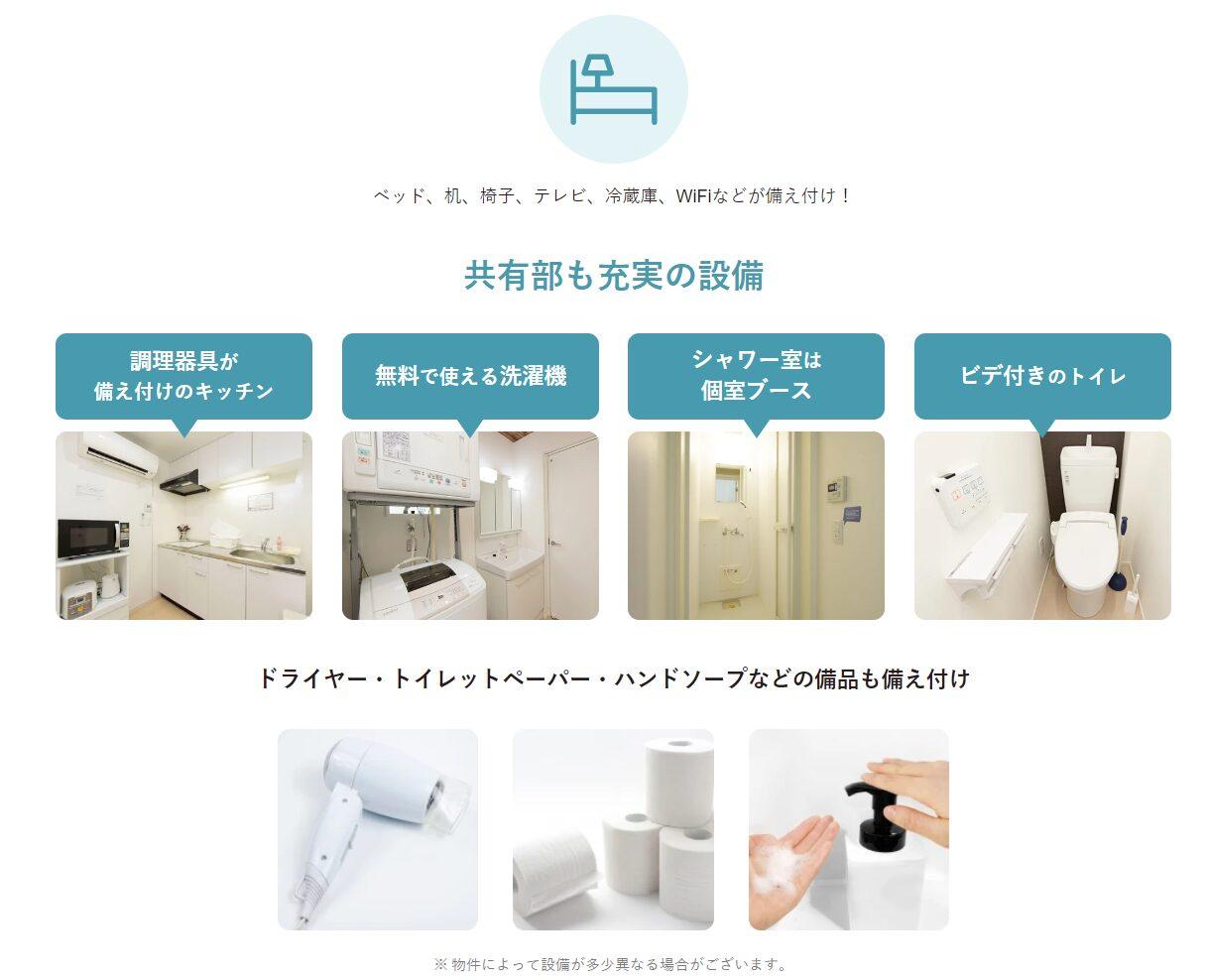
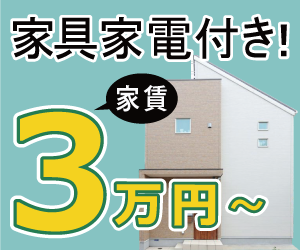
Xross House properties come fully furnished with furniture, appliances, and WiFi. Tenants don’t need to purchase new furniture or appliances and can immediately start comfortable living. This saves both the hassle and cost of buying and installing furniture/appliances, while high-speed WiFi ensures no internet connectivity issues. Xross House properties provide environments where foreigners can start Japanese life stress-free.
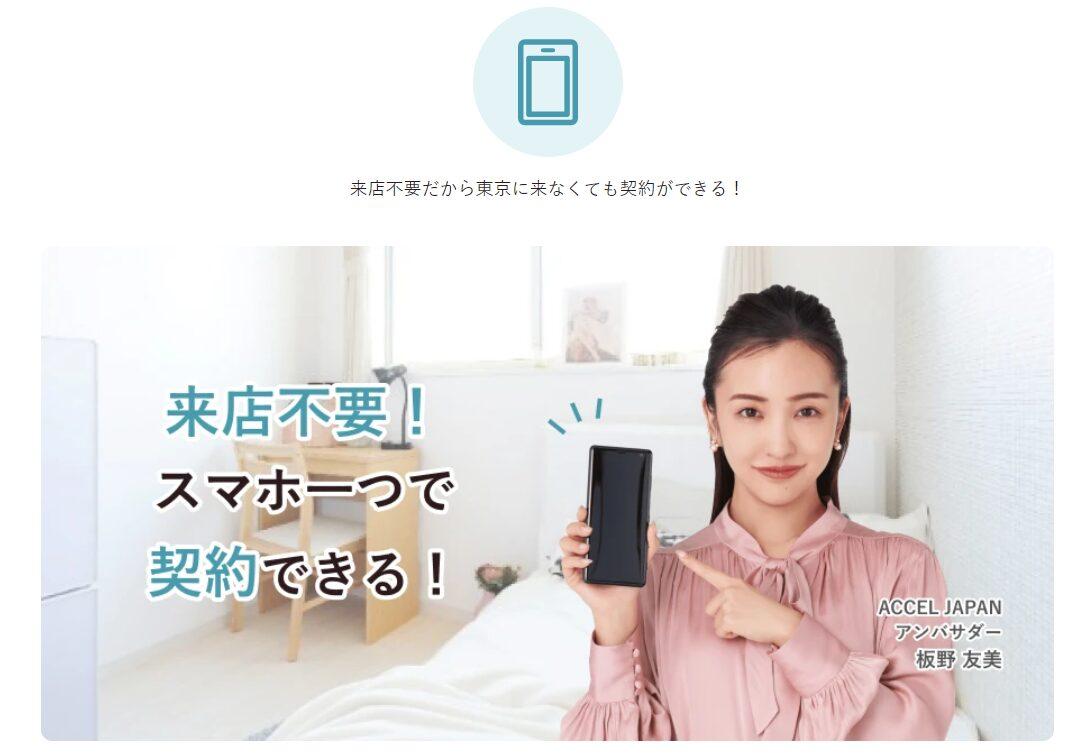
Web-Only Contracts with No Store Visits Required
Xross House uses smart locks operated by smartphones or dedicated remote controls for door access. While maintaining high security, there’s no worry about losing keys. Since there’s no need to receive keys in person during move-in, everything from property search to contract can be completed online. Overseas residents can sign web contracts before coming to Japan and enter rooms with smartphones after arrival.
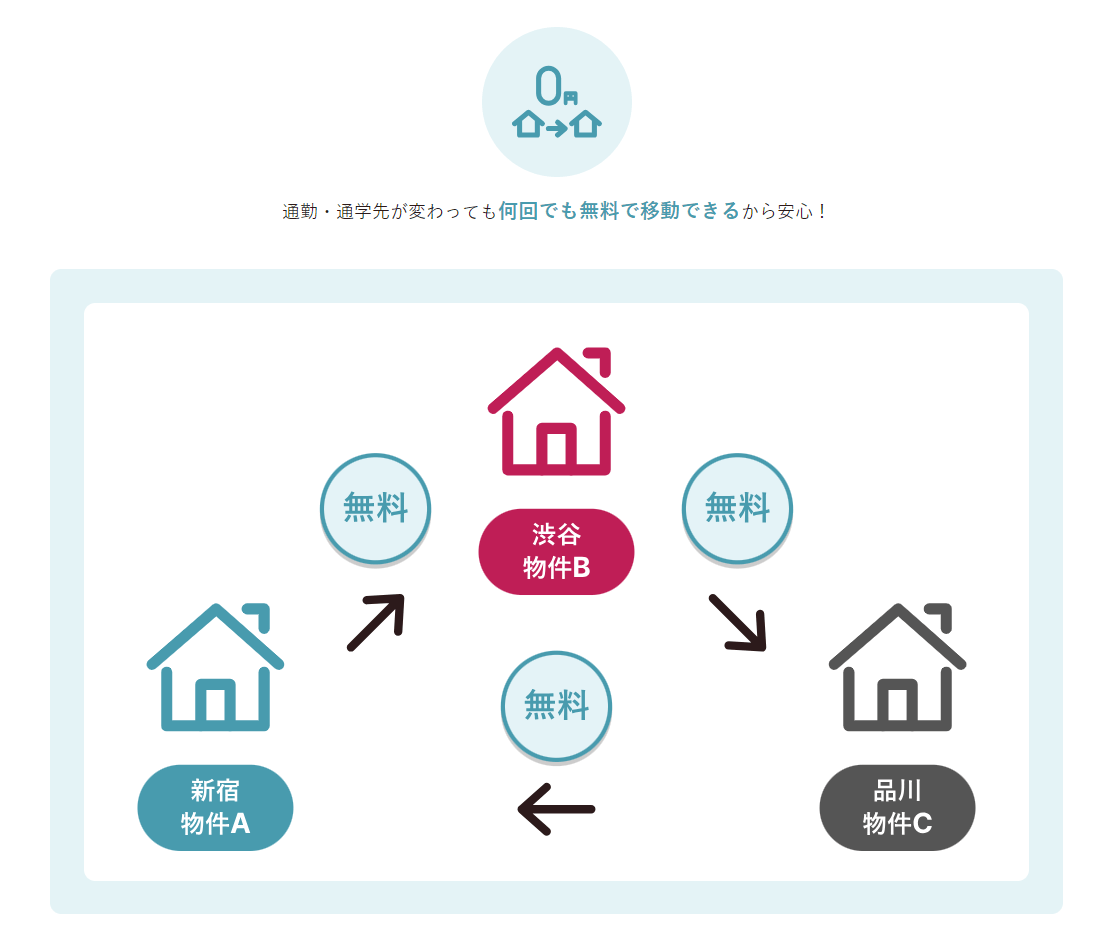
Free Property Transfers After Moving In
You can transfer between Xross House properties unlimited times for free. Free property transfers are possible when moving from Japanese language school to university or when changing jobs and commute locations. Tenants can respond flexibly to life and work changes without feeling extra burden. Since regular moves typically incur initial costs, Xross House is recommended for foreigners who may need to relocate due to school admission, employment, or job changes.
Job Introduction Services for Foreigners

Xross House has partnered with Marimo Holdings, an international human resources company, providing “job introduction support” for foreigners in addition to “housing.”
Four Room Types to Choose From
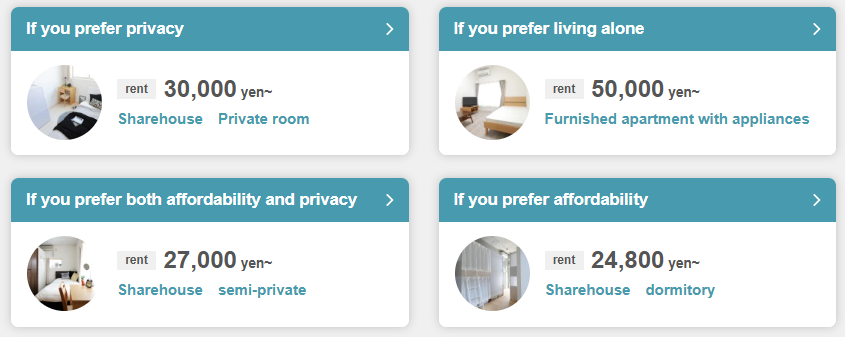
Xross House offers two property types: share houses and furnished apartments. Share houses are divided into three room types: private rooms, semi-private, and dormitory.
Share Houses
Share houses are rental properties with individual rooms plus shared common spaces. Compared to regular apartments, they offer lower initial and monthly costs at affordable prices. Common fees include water, electricity, and gas, with free WiFi.
| Private Room | Semi-Private | Dormitory | ||
| Initial Cost | Initial cost is 30,000 yen only | |||
|---|---|---|---|---|
| Monthly Cost | Rent | 40,000 yen~ | 34,800 yen~ | 24,800 yen~ |
| Common Fee | Flat 15,000 yen (includes water, electricity, gas, shared equipment) | |||
| System usage fee | Flat 1,000 yen (tax excluded) – covers all housing-related troubles and services | |||
Share House Private Rooms
Recommended for those wanting to keep rent low while valuing privacy. Private rooms are for individual use, perfect for those wanting “private space beyond shared areas.” Rooms include TV, refrigerator, bed, desk, chair, air conditioning, and drying facilities – essentially everything needed except water facilities. Rooms have locks, so there’s no worry about theft or other troubles.
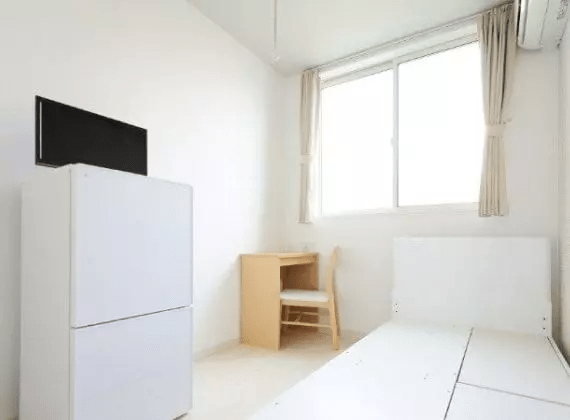
Those who want to prioritize their privacy and keep their rent low at the same time
Share House Semi-Private
Recommended for those wanting to keep rent low while valuing privacy more than dormitories. Semi-private rooms involve 2-3 people sharing large rooms divided by curtains or partitions. Minimal private space is maintained for individuals. Lighting and air conditioning are shared with roommates, while beds, storage, desks, chairs, and desk lights are individual.
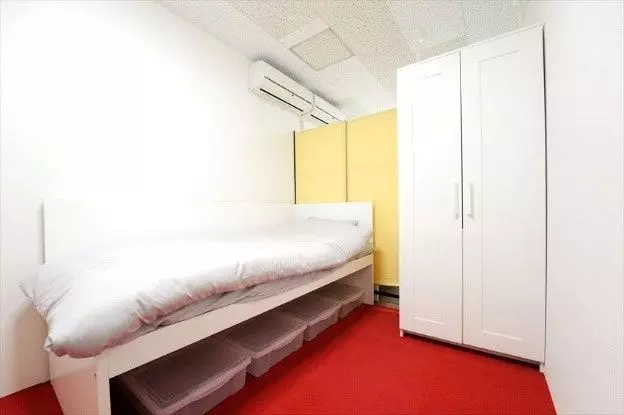
Those who want to keep rent low but still value more privacy than in a dormitory
Share House Dormitory
Xross House‘s cheapest room type where 3-8 people share one room with multiple bunk beds. Private space is limited to the bed area. Beds include clotheslines, lights, 3-outlet power strips, sliding tables, and storage boxes with necessary minimums.
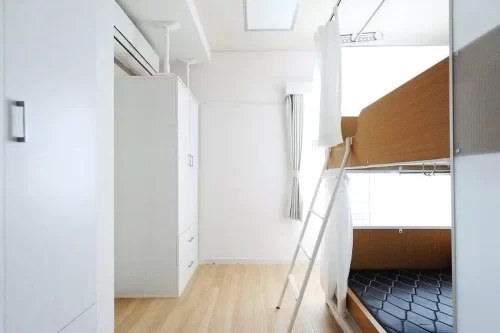
Those who value low prices and do not value privacy
Furnished Apartments
Furnished apartments are single-living rooms with complete furniture and appliances including beds, tables, TVs, refrigerators, microwaves, washing machines, and air conditioning. While regular rental properties typically cost about 5 times monthly rent in initial fees, Xross House furnished apartments cost only a flat 50,000 yen – dramatically cheaper than market rates.
| Initial Cost | Flat 50,000 yen |
|---|---|
| Rent | 60,000 yen (furnished with appliances) |
| Other | Water, electricity, gas, internet require individual contracts |
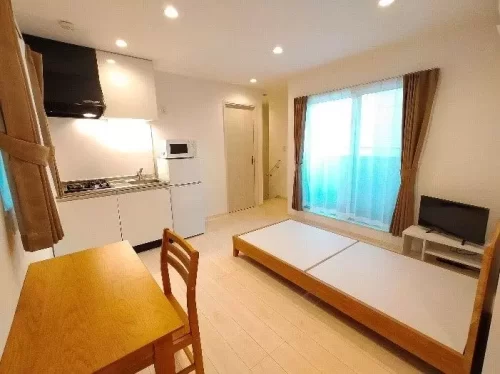
Those who want to live alone instead of in a shared house, but want to keep initial costs and rent low
Resident Reviews
Please check out the video below of an interview with a foreigner who actually lives in Xross House.
IVANA JORDANOVSKA
Move-in Process
Moving into Xross House is completed in four simple steps:
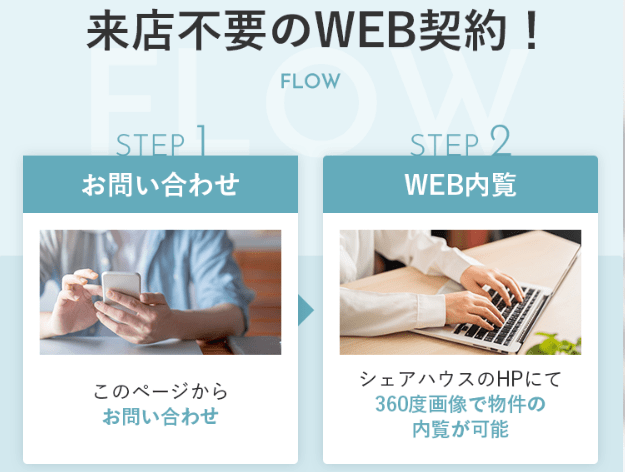
Step 1: Inquiry
First, decide on your desired area and budget, then contact them to connect with a representative.
Step 2: Property Tour
Next, conduct online property tours to check properties and facilities. On-site tours are also possible if desired.
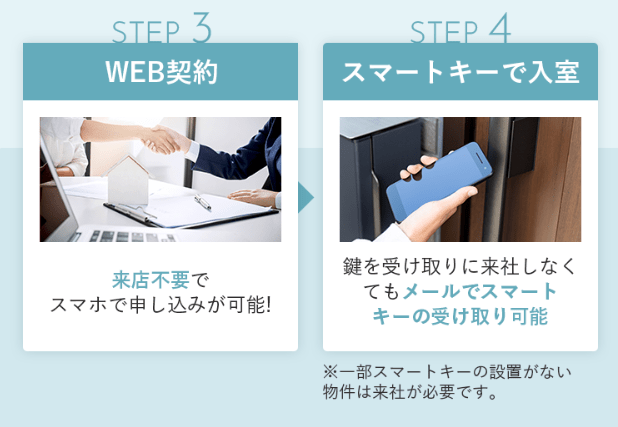
Step 3: Web Contract
Then, fill out the web contract form with necessary information to complete contract procedures.
Step 4: Smart Key Move-in
Finally, receive your smart key via email and complete move-in preparation.
Summary
Xross House is a reliable real estate company providing affordable rental properties for foreigners. They offer various support services to minimize initial costs and maintain stable living. Their services include multilingual support, furnished properties, web-only contracts, free property transfers, and job introductions – all tailored to tenant needs. Xross House maintains comprehensive support systems to help foreigners start their lives in Japan with confidence. Foreigners wanting to live affordably in well-located Tokyo areas should definitely explore Xross House properties.

If you have any questions about rental property searches for foreigners, please feel free to contact us through our inquiry form or social media DMs below.
Thank you for reading this article to the end! If you’d like to support JEC’s activities, we welcome support through Buy Me a Coffee. Your support helps us continue providing quality content. Thank you for your consideration!