
This post is also available in:
 日本語
日本語  Türkçe
Are you considering pursuing a master’s degree or PhD in Japan? This comprehensive guide will walk you through everything you need to know about applying to Japanese graduate programs, from admission requirements to scholarship opportunities that can make your academic dreams in Japan a reality.
Before reading this article, if you haven’t already seen our article on “8 Compelling Reasons to Study in Japan: Your Gateway to Academic Excellence and Career Success,” I strongly recommend reading it first.
- Graduate Program Admission Requirements
- Academic Calendar in Japanese Universities
- Duration of Japanese Graduate Programs
- Japanese Language Requirements for Graduate Programs
- Step-by-Step Application Process
- 1. Choose Your Research Topic
- 2. Find Your Academic Supervisor
- Websites to help you find an academic advisor
- Key Considerations When Choosing a Supervisor
- 1. Choose Supervisors with International Experience
- 2. Look for Research Groups with International Students
- 3. Ensure Adequate PhD Students and Postdocs in the Group
- 4. Check whether master’s and doctoral students are graduating on time
- 5. Agree on your post-graduation goals with your academic supervisor
- 6. Understand Work-Life Balance Expectations
- 7. Understand the relationship between your supervisor and other staff in the research group
- 3. Develop Your Research Proposal
- 4. Prepare Required Documents
- 5. Prepare for Entrance Examinations
- 6. Complete Visa Procedures After Acceptance
- Application Methods: Domestic vs. International
- Tuition Fees for Japanese Graduate Programs
- Scholarship Opportunities for International Students
- Summary
Graduate Program Admission Requirements
Master’s Program Eligibility
- Must have completed or be expecting to complete a bachelor’s degree from an accredited university
PhD Program Eligibility
- Must have completed or be expecting to complete a master’s degree program
These basic requirements form the foundation for international students seeking to study in Japan at the graduate level.
Academic Calendar in Japanese Universities

The Japanese academic year traditionally begins in April and runs through March of the following year. This means most master’s and PhD programs start in April. However, recognizing the needs of international students, many universities now offer September or October start dates for graduate programs designed specifically for overseas applicants.
Application processes typically begin 6 months to 1 year before the intended enrollment date. Each university has its own unique schedule, so we strongly recommend checking the application timeline and academic calendar of your target programs well in advance.
Duration of Japanese Graduate Programs
| Program Type | Duration |
| Master’s Program | 2 years |
| PhD Program | 3 years |
| Medical PhD Program | 4 years |
Japanese Language Requirements for Graduate Programs

One of the most common questions from prospective international students concerns language requirements. Generally, programs designed for international students can be completed entirely in English, with no Japanese language proficiency required. However, if you’re applying from within Japan to programs alongside Japanese students, Japanese language skills typically become mandatory.
Key Point: English-taught programs are increasingly available at top Japanese universities, making graduate study accessible to international students regardless of their Japanese language ability.
Step-by-Step Application Process
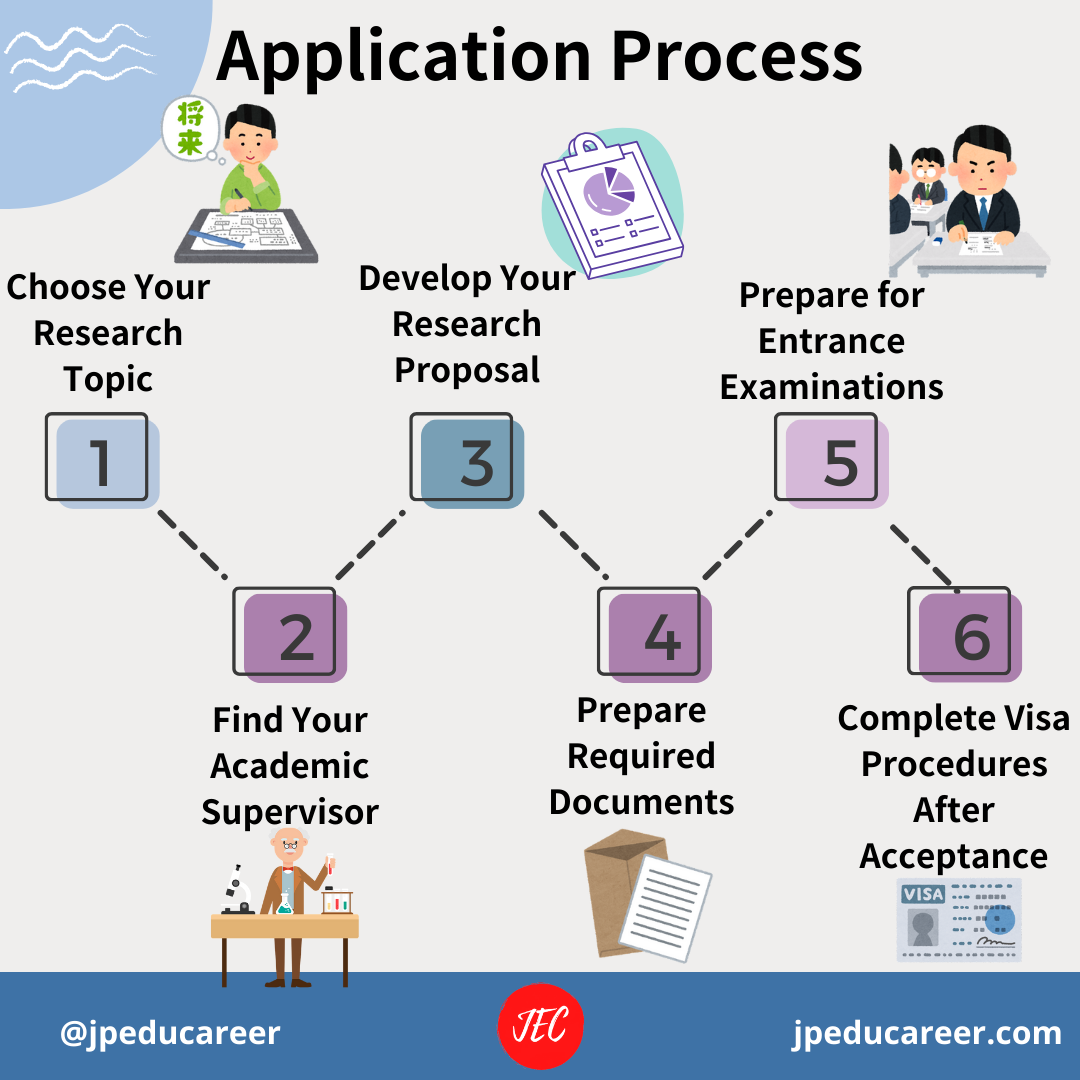
The application process differs depending on the university, program, and type of scholarship, so it is important to check the specific requirements for each program individually. This article provides an overview of the general application process to help you better understand how it works.
1. Choose Your Research Topic
Unlike undergraduate applications, graduate program success depends heavily on finding the right research fit. Don’t just apply to famous universities—focus on finding professors conducting research that genuinely interests you. Choosing a research area solely based on scholarship availability without genuine interest can lead to communication problems with supervisors and difficulty completing your program.
Select research topics that align with your background, spark genuine curiosity, and keep you engaged with the latest developments in the field.
2. Find Your Academic Supervisor

Once you’ve broadly decided on a research topic, the next step is to find a faculty member to act as your academic supervisor. Your supervisor will have a major influence on your future academic career, so take care when choosing who to work with.
Websites to help you find an academic advisor
You can use the following websites to check whether a potential academic supervisor has the expertise and research background to guide you in your chosen topic:
Key Considerations When Choosing a Supervisor
1. Choose Supervisors with International Experience
Professors who have studied or worked abroad often better understand the challenges international students face. They’re more likely to communicate effectively in English and maintain an international perspective that benefits foreign students.
2. Look for Research Groups with International Students
Groups that currently include or have previously hosted international students indicate familiarity with supporting foreign researchers. This makes your integration process smoother and less stressful.
3. Ensure Adequate PhD Students and Postdocs in the Group
Even if you choose an excellent academic supervisor, they will likely be very busy. In practice, much of your day-to-day guidance will come from experienced PhD students and postdocs in the research group. If the group does not have enough of them to support you closely, you will need to depend more on your supervisor’s limited time, which can slow down the progress of your research.
4. Check whether master’s and doctoral students are graduating on time
Some academic supervisors only aim to publish in top journals within their field. If a master’s or doctoral project is not yet at the required level, they may ask the student to continue working until it is. While this approach may lead to higher-quality publications, it could also cost you one or two additional years. If you are on a scholarship, there is a strong chance it will be terminated if your program is extended. However, if both you and your supervisor agree to the extension, you can ask your supervisor to help secure additional funding.
5. Agree on your post-graduation goals with your academic supervisor
We recommend discussing your post-graduation plans clearly at the application stage—whether you intend to seek employment after graduation, remain in academia, return to your home country, or pursue a career in Japan. If you plan to work in Japan, keep in mind that you will need to dedicate part of your time to job hunting, which may take away from your research. Some faculty members expect students to focus exclusively on research and may not support job hunting during a master’s or doctoral program. Addressing these issues early will help you avoid future conflicts. If it becomes clear that your supervisor’s expectations do not align with your goals, you will still have the opportunity to reach out to other faculty members.
6. Understand Work-Life Balance Expectations
Research group culture varies significantly. Before joining, ask current group members about weekend work expectations, vacation time, and overall work-life balance to ensure compatibility with your lifestyle.
7. Understand the relationship between your supervisor and other staff in the research group
How well people get along in a lab can make a huge difference to your research life. In Japan, it’s not unusual for tensions to arise between professors and associate professors in the same group. If you’re supervised by an associate professor but the professor has the final say, you might get stuck between their conflicting opinions—wasting time on politics instead of research. To avoid this, try reaching out to current students in the lab and ask about the atmosphere and relationships among the staff before you commit.
3. Develop Your Research Proposal

Before applying to universities, you must secure acceptance from a potential supervisor. Contact professors whose research aligns with your interests, expressing genuine enthusiasm for their work and your desire to join their research group.
Your initial contact should include:
- Detailed explanation of your previous research experience
- Specific research interests within the professor’s field
- How you can contribute to ongoing projects
- Evidence of thorough familiarity with the professor’s recent publications
Approach this as a mutually beneficial relationship. Show how you can contribute to the professor’s research goals, not just what you hope to gain.
- Essential Elements for Effective Professor Contact:
- Read the professor’s publications thoroughly to understand their research focus
- Write respectfully (respect is highly valued in Japanese academic culture)
- Provide specific reasons why you chose this particular professor
- Propose new research projects related to the professor’s current work
- Share any academic achievements, publications, or conference presentations
- Include recommendation letters from current professors if available
- Demonstrate both what you seek and what you can contribute
If your supervisor accepts you, they may ask you to write a research plan based on your discussions, or they might share a draft with you and work together to finalize it.
4. Prepare Required Documents

After securing supervisor agreement, prepare your formal university application. While requirements vary by program, typical documents include:
- Application form
- Bachelor’s degree certificate (or proof of expected graduation)
- Undergraduate transcripts
- Master’s degree certificate (PhD programs only)
- Graduate transcripts (PhD programs only)
- Recommendation letters
- Thesis abstract
- Research proposal (developed with your potential supervisor)
- English proficiency certificate (TOEFL, TOEIC, or IELTS)
- Resume/CV
- Passport copy
- Application fee payment proof
5. Prepare for Entrance Examinations

Admission processes vary by program. Some universities make decisions based solely on application documents, while others require additional entrance examinations including interviews and written tests. Research your specific program requirements early in your application process.
6. Complete Visa Procedures After Acceptance

Upon acceptance, you’ll need to complete student visa procedures. Universities will provide a Certificate of Eligibility (COE), which you’ll use to apply for a student visa at the Japanese embassy or consulate in your home country.

Application Methods: Domestic vs. International

1. Applying from Outside Japan (Recommended)
This is the preferred method for international students, offering several advantages:
- Access to international student scholarships and support programs
- Generally higher acceptance rates
- Programs designed specifically for foreign students
- English-language instruction options
2. Applying from Within Japan (Not Recommended)
Unless you have special circumstances, avoid this application method because:
- You’ll compete directly with Japanese students on equal terms
- Examinations are primarily conducted in Japanese
- You’ll lose access to major scholarship programs like MEXT scholarships designed for overseas applicants
- Significantly more challenging admission process for international students
Tuition Fees for Japanese Graduate Programs
Understanding the financial commitment is crucial for planning your studies in Japan. Here are average annual costs:
| Master’s Programs | Admission Fee (¥) | Tuition Fee (¥) | Total (¥) |
| National Universities | 282,000 | 535,800 | 817,800 |
| Private Universities | 201,752 | 798,465 | 1,000,217 |
| PhD Programs | Admission Fee (¥) | Tuition Fee (¥) | Total (¥) |
| National Universities | 282,000 | 520,800 | 802,800 |
| Private Universities | 192,686 | 604,592 | 797,278 |
Note: Actual fees vary by institution. Always verify costs with your target university’s official website.
Scholarship Opportunities for International Students

Next, let me introduce scholarship opportunities, which many of you are interested in. There are countless scholarships available for master’s and PhD programs in Japan. Some scholarships can be applied for simultaneously with your program application, while others become available after acceptance. Among post-acceptance scholarships, some can be applied for before traveling to Japan, while others require you to apply after arriving in Japan on a student visa.
Scholarships are provided by various organizations including government agencies such as the Ministry of Education, Culture, Sports, Science and Technology (MEXT) and the Japan Student Services Organization (JASSO), as well as universities and private foundations. Notably, since Japan hosts a large number of students from Asia, there are cases where preferential treatment is given to students from Europe for the purpose of enhancing student diversity.
Types of Scholarships
MEXT Scholarships
There are two types of MEXT scholarships available for master’s and doctoral students in Japan:
1- Embassy Recommendation Track
This scholarship application is conducted in two stages.
- Stage 1: Applicants apply to the Japanese embassy or consulate in their country of residence.
- Stage 2: If you pass the first stage, you must obtain a “letter of acceptance” from the university offering your desired master’s or PhD program and submit it to the embassy (or consulate). The embassy then recommends the candidate to MEXT along with the letter of acceptance.
Each year, a certain number of students are selected from each country. Applications typically begin around April, with final results announced in January of the following year.
For detailed information about the Embassy Recommendation MEXT Scholarship, please click here.
2- University Recommendation Track
With this scholarship, you apply through your desired university.
- First, find a professor who can accept you, develop a research proposal with that professor, and apply to the university.
- The university then recommends you to MEXT, and if selected, you receive the scholarship.
Applications typically begin around September, with results announced in August of the following year. Successful candidates arrive in Japan in September.
Here are some master’s and PhD programs eligible for the MEXT scholarship through university recommendation.
University-Specific Scholarships
Many Japanese universities offer their own scholarship programs to:
- Increase international student enrollment
- Address graduate program capacity needs
- Enhance campus diversity
We recommend checking the scholarship system of your chosen university before applying.
Supervisor-Funded Scholarships
Professors with industry research partnerships or large research grants may offer funding opportunities for students participating in specific projects. Don’t hesitate to discuss available funding options with potential supervisors.
JASSO Scholarships
After being accepted, you can apply for scholarships offered by JASSO through your university. Applications can be made before or after your arrival in Japan.
Private Foundation Scholarships
Many private organizations also offer scholarships for international students. There are two types:
- Those requiring recommendation letters
- Those that can be freely applied to without recommendation letters
Requirements vary depending on each scholarship.
Finding the Right Scholarships
1. First, get information about available scholarships from the international student office of your admitted university
2. Utilize the following resources for comprehensive scholarship searches:
Summary
Successfully applying to Japanese graduate programs requires strategic planning, genuine research interest, and careful attention to the supervisor selection process. Remember that you’re not just applying to a university—you’re applying to work with a specific professor who will shape your academic future.
The key to success lies in finding genuine alignment between your research interests and a professor’s work, rather than simply choosing prestigious institutions. This authentic match will make both the application process and your subsequent research experience more rewarding and productive.
- Start planning 6-12 months before desired enrollment
- Focus on finding the right research supervisor, not just prestigious universities
- Apply from outside Japan when possible for maximum scholarship opportunities
- Thoroughly research potential supervisors and their research groups
- Prepare authentic, well-researched applications that demonstrate genuine interest
- Consider financial planning early, including scholarship applications
Japan offers world-class graduate education opportunities with substantial scholarship support for international students. With proper preparation and strategic application, you can join the ranks of successful international researchers contributing to Japan’s vibrant academic community.
Your journey to graduate study in Japan starts with taking that first step toward research that genuinely excites you. Best of luck with your applications!
If you have any questions, please feel free to contact us via social media or fill out the contact form below.
If you found this article or our activities helpful, we would greatly appreciate your support with a cup of coffee ☕✨